|
Crash - Halifax - type B VII - s/n NP706 QO°J |

|
|
|
Crash - Halifax - type B VII - s/n NP706 QO°J |
|
| Fiche France-Crashes 39-45 modifiée le 26-09-2025 | |||||
| Date | Nation |
 Département Département |
Unité | Macr | Mission |
|---|---|---|---|---|---|
| 18-07-1944 | Angleterre/Common. | Calvados | 432 Sq All Weather RCAF 6 Gr | 9715 | Caen (14) : attaque de concentration de troupes |
| Localisation | Près de Boulon - S de Caen |
|---|---|
| Circonstances | Touché, après le bombardement, par la flak légère au milieu et à l'arrière de l"avion - Avion en feu évacué en parachute - 05h58 |
| Commentaires | Décollage 03h26 le 18/07 East Moor, Norfolk UK |
| Sources ** |
Listes des bombardiers et équipages perdus: Royal Air Force - Bomber Command Losses of the Second World War par WR Listes des bombardiers et équipages perdus: Royal Air Force - Bomber Command Losses of the Second World War par WR Chorley WR Chorley / CWGC / BomberCommand / LostBombers / National Archives UK-Operations record bookORB27-1860-30 / Nat Arch US-page 90 / Nat Archives UK / G Leroy (source: Rapport MREU) / Ancestry.fr (sources: Quest PoW / Généalogie) |
| Historique | 21/07/2013=Ajout Butkewitz,prénoms,matricules - 19/06/2021=Modif postes.Ajout comm équip,prénoms - 26/10/2021=Ajout rapports - 31/10/2021=Ajout rapp Browne,photo - 26/09/2025=Ajout MREU,Comm équip |
| Grade | Prenom | Nom | Poste | Corps | Etat |
Lieu d'Inhumation |
Commentaires |
|---|---|---|---|---|---|---|---|
| T/Sgt | Leo Joseph | Butkewitz | Rad/M | USAAF | Prisonnier | 10601605 - Né le 18/01/1922 Naperville, Illinois USA - Fils de Stanley P et Anna Butkewitz - 29 missions - Blessé à la cheville au parachutage - Capturé le 24/07/1944 - Prison de Chartres (28)/Stalag VI-D (16/08/44)/Stalag IV-D Neuburxdorf (09/09/44)/Stalag III-A Luckenwalde (06/04/45-20/05/45) - †2000 | |
| F/Lt | John Herbert | Cooper | Pil | RCAF | Prisonnier | J/6642 - Né le 29/11/1918 Qu'Appelle, Sask. Canada - Fils de John Goodwin et Annie Augusta (Pinder) Cooper - Conjoint de Doris Bricker - 31 missions - Capturé le 21/07/1944 au S de Caen - Pow 7607 - Dulag Luft Oberursel (31/07/44)/Dulag Luft Wetzlar (26/08/44)/Stalag Luft III Sagan (30/08/44)28/01/45)/Marlag-Milag Tarmstedt (06/02/45-20/04/45) - †2010 | |
| Sgt | Samuel Dawson | Wright | 2ePil | RCAF | Prisonnier | R/164205 - Né le 02/10/1918 Windsor, Ontario, Canada - Fils de Orville Dawson et Violet Beatrice (Buchanan) Wright - Conjoint de Geraldine Eleanor Warren - Capturé le 18/07/44 à Tours (37) - Pow 500 - Stalag Luft VII Bankau (08/44-19/01/45)/Stalag III-A Luckenwalde (09/02/45-08/05/45) - †2005 | |
| Sgt | Henry Ernest | Oakeby | Mec | RAF | Echappé | 928958 - Né le 16/12/1920 - London UK - 29 missions - Se pose au SE de Caen - Récupéré le 18/08 par une patrouille anglaise - Rapport WO 208/3349/352 - †1998 | |
| F/O | Robert Page | Dryden | Nav | RCAF | Prisonnier | J/24224 - Né le 23/09/1921 Galt, Ontario, Canada - Fils de Victor Carlton et Grace (Page) Dryden - Conjoint de Edith Evelyun Fenton - 29 missions - Capturé le 22/07/44 - Pow 5171 - Stalag Luft I Barth - †1974 Toronto | |
| W/O2 | Alexander Orest | Zacharuk | Bomb | RCAF | Evadé | R/159288 - Né le 02/07/1923 Mirror, Alberta, Canada - Fils de Stephenus et Alexandra Celia (Yaholnitsky) Zacharuk - 29 missions - Blessé à la hanche - Capturé, s'évade 2 jours après - Lien d'origine WO 208/3324/2661 - †1974 Edmonton | |
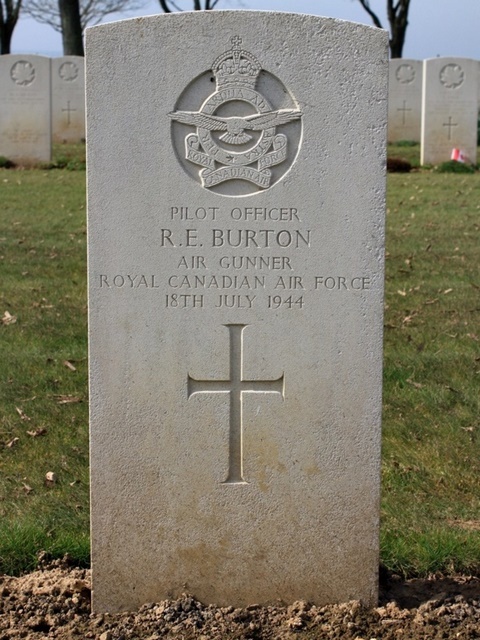
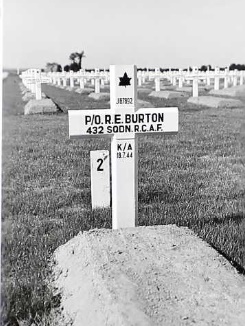
| F/Sgt | Robert Elwood | Burton | MitS | RCAF | Décédé | Cim Mil Canadien Bretteville-sur-Laize (14) - Plan - XIV.A2 * | R/206263 - 20 ans - Né le 04/04/1924 Timmins, Ontario, Canada - Fils de Norman et Margaret (Kearns) Burton - 29 missions |
| W/O1 | Kenneth Karl | Elliott | MitA | RCAF | Prisonnier | R/158470 - Né le 14/07/1921 Lanigan, Sask. Canada - Fils de Hezeklah et Errol Christina (Gregory) Elliott - Conjoint de Kathleen Annabel Robinson - 29 missions - Capturé le 18/07/44 - Pow 452 - Stalag Luft VII Bankau (08/08/44-19/01/45)/Stalag III-A Luckenwalde (08/02/45-24/05/45) - †2020 |
| Fiche tech | Correspondance grades | Abréviations utilisées | Filières d'évasion | Camps de Pow | Bases RAF/USAAF | Utilitaires |
|---|
|
Rapport du Sgt Henry E Oakeby - ( I was the flight engineer in a Halifax aircraft detailed to attack a concentration of German armour S of Caen on the morning of the 18 Jul 44. The visibility was good and we bombed from 9,000 feet. On our turning point, however, we were hit by light flak amidships and in the tail. A fire started amidships and I used 3 fire extinguishers to not avail. The pilot then gave the order to abandon aircraft on the intercom. I was the fourth to leave the aircraft from the front exit and saw two parachutes leave the aircraft after me. Probably the pilot and wireless operator. I had pulled the leg of the mid-upper gunner before leaving, in case the intercom had not worked, but failed to get any response. I assumed , therefore, that he was either killed by the flak or overcome by the fumes of the fire. I landed in a lightly wooded area unhurt, the time being approx 0600 hrs. I estimate my position as being Sheet 7, 948472. I headed North as I was not shure whether I had dropped in the British or German lines, and if in German lines I wanted to get away from the scene of my descent as quickly as possible. Soon after, I came to the banks of the River Orne. Typhoons and Lightnings started dive-bombing this area. I tought it best to move and waded across. I scaled the West bank which was high. I turned South along the banks of the River and about 15 minutes later met a French family. They took me in and gave me civilian clothes. In actual fact they were sheltering in a cave on the bank of the Orne, their house further upthe road having been commandeered by the Germans. This family were sheltering a German deserter and had been doing so for about 4 months. He was about 24 years old. He posed as a deaf and dumb refugee. I was also given a fake identity card and posed as a deaf and dumb refugee brother of the deserter.Original) - (source : National Archives de Kew – WO208/3349/352 – Part I - Traduction Google): "J'étais mécanicien navigant dans un avion Halifax chargé d'attaquer une concentration de blindés allemands au S de Caen le matin du 18 juillet 44. La visibilité était bonne et nous avons bombardé à 9 000 pieds. À notre tournant, cependant, nous avons été touchés par une légère flak au milieu et à la queue. Un incendie s'est déclaré au milieu de l’avion et j'ai utilisé 3 extincteurs sans succès. Le pilote a alors donné l'ordre d'abandonner l'avion sur l'intercom. J'étais le quatrième à quitter l'avion par la sortie avant et j'ai vu deux parachutes quitter l'avion après moi. Probablement le pilote et l'opérateur radio. J'avais tiré sur la jambe du mitrailleur supérieur avant de partir, au cas où l'intercom n'aurait pas fonctionné, mais je n'ai obtenu aucune réponse. J'ai donc supposé qu'il avait été tué par la flak ou asphixié par les fumées de l'incendie. J'ai atterri indemne dans une zone légèrement boisée, à environ 6h00. J'estime ma position comme étant sur la feuille 7, 948472. Je me dirigeais vers le nord car je ne savais pas si j’étais tombé dans les lignes britanniques ou allemandes, et si dans les lignes allemandes je voulais m'éloigner le plus rapidement possible du lieu de ma descente. Peu de temps après, je suis arrivé au bord de l'Orne. Les Typhon et les Lightning ont commencé à bombarder en piqué cette zone. J'ai pensé qu'il valait mieux bouger et j'ai traversé à gué. J'ai escaladé la rive qui était haute. J'ai tourné vers le sud le long des rives de la rivière et environ 15 minutes plus tard, j'ai rencontré une famille française. Ils m'ont recueilli et m'ont donné des vêtements civils. En réalité, ils s'abritaient dans une grotte au bord de l'Orne, leur maison plus haut sur la route ayant été réquisitionnée par les Allemands. Cette famille abritait un déserteur allemand depuis environ 4 mois. Il avait environ 24 ans. Il s'est fait passer pour un réfugié sourd-muet. On m'a aussi donné une fausse carte d'identité et je me suis fait passer pour le frère sourd-muet réfugié du déserteur." Rapport du Sgt Henry E Oakeby - ( On the 25 Jul 2 S.S. officers came and ordered us to evacuate South. Their artillery was retiring on to positions near to where we had been sheltering. We were given 3 hours in which to move. That afternoon we started off on foot to Cauville (870428) where the patron had a brother. We reached Cauville at about 2200 hrs and found that the civilians expected Cauville to be evacuated shortly. We, thereford, stayed here only 3 days before moving on to St Denis de Mere (906340) where we were put up in a barn by a farmer. Our party had increased up to approx 25 refugees when we had collected on the road. The plan appeared to be to stay as near the lines as possible for the talked of encircling movement by the British to take place, and thereby not have far to return to their home, near where I had landed. We moved off from here on the fourth day, which was 1 Aug. The battle line kept on catching us up from the rear. Our stopping place this time was St Honorine la Chardonne (927289) where we stayed in an empty house. On the way here our identity cards were checked by French gendarmes. Mine was glanced at and turned back. Here again the battle front approached us from the rear and we moved off on the 9th day. We moved off and reached Chendouit (032214) at about 2000 hrs. We stayed in a barn for the first two days. By about the 14th Aug artillery fire was audible from all directions, though the village itself was not actually shelled. The family and myself kept out of sight in the barn which was very solidly built. On the morning of 18 Aug a British patrol passed through the village. I was then taken back to Corps H.Q. and from there I was transported to I.S.9.Original) - (source : National Archives de Kew – WO208/3349/352 – Part II - Traduction Google): "Le 25 juillet, des officiers S.S. sont venus et nous ont ordonné d'évacuer vers le sud. Leur artillerie se retirait sur des positions proches de l'endroit où nous nous étions réfugiés. On nous a donné 3 heures pour nous déplacer. Cet après-midi-là, nous sommes partis à pied vers Cauville (870428) où le patron avait un frère. Nous sommes arrivés à Cauville vers 22h00 et avons constaté que les civils s'attendaient à ce que Cauville soit évacué sous peu. Nous ne sommes donc restés ici que 3 jours avant de passer à St Denis de Mère (906340) où nous avons été hébergés dans une grange par un agriculteur. Notre groupe était passé à environ 25 réfugiés lorsque nous nous étions rassemblés sur la route. Le plan semblait être de rester aussi près des lignes que possible pour que le mouvement d'encerclement évoqué par les Britanniques ait lieu, et ainsi ne pas avoir loin pour retourner chez eux, près de l'endroit où j'avais débarqué. Nous sommes partis d'ici le quatrième jour, qui était le 1er août. La ligne de bataille n'arrêtait pas de nous rattraper par l'arrière. Notre arrêt à ce moment était St Honorine la Chardonne (927289) où nous sommes restés dans une maison vide. En chemin, nos cartes d'identité ont été contrôlées par des gendarmes français. La mienne a été regardée et retournée. Là encore, le front de bataille s'est approché de nous par l'arrière et nous avons démarré le 9ème jour. Nous avons atteint Chendouit (032214) vers 2000 heures. Nous sommes restés dans une grange pendant les deux premiers jours. Vers le 14 août, des tirs d'artillerie étaient audibles de toutes les directions, bien que le village lui-même n'ait pas été bombardé. La famille et moi-même sommes restés hors de vue dans la grange qui était très solidement construite. Le matin du 18 août, une patrouille britannique a traversé le village. J'ai ensuite été ramené au QG du Corps. et de là, j'ai été transporté à I.S.9." Rapport du Sgt Henry E Oakeby - (The name of the man I was with during the month of my evasion was M. Barette. He was a man of 56 with a ruddy complexion. His wife was called Jeanne and he had a son aged about 19 called Jean. His farm is situated in the vicinity of Le Hom. The German deserter went by the name of André Huard. He was 25 ans years old, very fair, abour 5' 7" in height, of medium build. He invariably wore a black leather jacket.Original) - (source : National Archives de Kew – WO208/3349/352 – APPENDIX C - Traduction Google): "Le nom de l'homme avec qui j'étais pendant le mois de mon évasion était M. Barette. C'était un homme de 56 ans au teint roux. Sa femme s'appelait Jeanne et il avait un fils d'environ 19 ans qui s'appelait Jean. Sa ferme est située à proximité de Le Hom. Le déserteur allemand s'appelait André Huard. Il avait 25 ans, très blond, mesurant environ 5' 7" de hauteur, de corpulence moyenne. Il portait invariablement une veste en cuir noir." Rapport du W/O Alex Zacharuk - (I was a member of the same crew as Sgt Oakeby. We took off from Eastmoor in a Halifax aircraft at 0300 hours on 18 Jul 44 to attack a concentration of Germans armour South of Caen (U 06). After we had dropped our bomb load we were hit by flak and the aircraft was set on fire. I came down in the Caen area about 0600 hours (18 Jul). I had several wounds on my left hip. I was captured by German troops before I had time to dispose of my parachute and flying kit. I was taken to a camp about five miles from Falaise (U 13) xhere I met Lt B R Browne, 9th Bn, Parachute Regiment, (S/PG 2139), F/Lt Campbell, a Spitfire pilot, 2Lt Rudolph Augarden, an American, and a private (name unknown) who was a member of the 12th Bn Parachute Regiment. On 20 Jul we sawed through the ceiling of the stable in which we were housed with a small key saw used for cutting bread. We pushed the boards up and later that night (20 Jul) we got into a barn. We then lowered ourselves on a rope made from blankets and parachute ripcord on to a road which ran to the main entrance of the camp. We went off in pairs, my companion being Lieut Browne. The remainder of my story is as related in Browne's report.Original) - (source : National Archives de Kew – WO208/3324/2661 - Traduction Google): "J'étais membre du même équipage que le Sgt Oakeby. Nous avons décollé d'Eastmoor à bord d'un avion Halifax à 03h00 le 18 juillet 44 pour attaquer une concentration de blindés allemands au sud de Caen (U 06). Après avoir largué notre charge de bombes, nous avons été touchés par la flak et l'avion a été incendié. Je suis descendu dans la région de Caen vers 06h00 (18 juillet). J'avais plusieurs blessures à la hanche gauche. J'ai été capturé par les troupes allemandes avant d'avoir eu le temps de disposer de mon parachute et de mon kit de vol. J'ai été emmené dans un camp à environ huit kilomètres de Falaise (U 13) où j'ai rencontré le Lt BR Browne, 9th Bn, Parachute Regiment, (S/PG 2139), le F/Lt Campbell, un pilote de Spitfire, le Slt Rudolph Augarden [Fiche], un Américain, et un soldat (nom inconnu) qui était membre du 12th Bn Parachute Regiment. Le 20 juillet, nous avons scié à travers le plafond de l'écurie dans laquelle nous étions logés avec une petite scie à clé utilisée pour couper le pain. Nous avons poussé les planches et plus tard dans la nuit (20 juillet), nous sommes entrés dans une grange. Nous sommes ensuite descendus avec une corde faite de couvertures et de corde de parachute sur une route qui allait jusqu'à l'entrée principale du camp. Nous sommes partis à deux, mon compagnon étant le lieutenant Browne (S/PG 2139). Le reste de mon histoire est comme relaté dans le rapport de Browne." Extrait du rapport du Pvt Browne - (We went due South and arrived near Courtelle (U 1423), where we eventually made contact with some members of the resistance movement. They hid us between Courtelle and Giel (U 1422) in a barn till about 2 Aug. From here we moved in plain clothes with the resistance people to Habloville (U 1624). We were here till about 15 Aug in a room next to a cafe. We helped the resistance in the use of their arms and assisted them on their raids. After being chased and hiding again in a barn at Montgaroult (U 1920) we made our way to our own lines, reaching them two kilometres from Ecouche (U 1816. We were evacuated to Bayeux and left Normandy on 23 Aug.Original) - (source : National Archives de Kew – WO208/3321/2139 - Traduction Google): "Nous sommes allés plein sud et sommes arrivés près de Courteilles (U 1423), où nous avons fini par entrer en contact avec quelques résistants. Ils nous ont cachés entre Courteilles et Giel (U 1422) dans une grange jusqu'au 2 août environ. De là, nous nous sommes déplacés en civil avec les résistants jusqu'à Habloville (U 1624). Nous étions ici jusqu'au 15 août environ dans une pièce à côté d'un café. Nous avons aidé la résistance dans l'utilisation de leurs armes et les avons assistés dans leurs raids. Après avoir été pourchassés et cachés à nouveau dans une grange à Montgaroult ( U 1920) nous nous sommes dirigés vers nos propres lignes, les atteignant à deux kilomètres d'Ecouche (U 1816. Nous avons été évacués vers Bayeux et avons quitté la Normandie le 23 août." Extrait du Missing, Research & Enquiry UnitMREU (PLACE OF CRASH, WITH MAP REFERENCE: Boulon. U.000553. RESULT OF INVESTIGATION AND FINDING: Spread over two or three fields belonging to M. Cholet - farmer of Boulon is the wreckage of a Halifax aircraft. On the side of the fuselage can be seen the two letters Q.O. whilst on another part I found in letters about 10' inches high the number N.P. 706 which is presumably the number of the aircraft. A small plaque on the fin had Halifax Serial No: 12184 A. on it. According to witnesses the plane fell at 5.50 on the morning of 18th July, 1944. It blew up in mid-air and pieces are scattered over a very wide area. Only one body was found in the plane and it is thought that the rest of the crew escaped by parachute. The body which was found was half burned and was buried in the garden of a Château belonging to Mme.Caraes of Boulon. She told me that the identity of the airman was known, that he was a Canadian and that he had been removed by the Canadian Graves Concentration Unit on 8th September, 1945, and buried, she thought, in Bretteville Canadian Cemetery. She did not remember the name but if the identity of the airman can be discovered from the informaticm supplied, it should be a simple matter to find the location of his grave from the Canadian Graves Registration Units. Original) - (1 MREU/S.8/XF1464/Air - source : Nat Arch UK - Traduction DC via Google Lens): Place of crash, avec référence carte: Boulon. vU0035. Résultat de l'enquête et des constatations : Éparpillées sur deux ou trois champs appartenant à Mr Cholet, agriculteur à Boulon, se trouvent les débris d'un avion Halifax. Sur le côté du fuselage, on peut voir les deux lettres Q.O., tandis que sur une autre partie, j'ai trouvé, en lettres d'environ 25 cm de haut, le numéro N.P. 706, vraisemblablement le numéro de l'avion. Une petite plaque sur la dérive portait le numéro de série Halifax : 12184 A. D'après des témoins, l'avion s'est écrasé à 5 h 50 le matin du 18 juillet 1944. Il a explosé en plein vol et des débris sont dispersés sur une vaste zone. Un seul corps a été retrouvé à bord et on pense que le reste de l'équipage a pu s'échapper en parachute. Le corps retrouvé était à moitié brûlé et a été enterré dans le jardin d'un château appartenant à Mme Caraes de Boulon. Elle m'a dit que l'identité de l'aviateur était connue, qu'il était Canadien et qu'il avait été retiré par l'Unité canadienne de concentration des sépultures le 8 septembre 1945 et enterré, pensait-elle, au cimetière canadien de Bretteville. Elle ne se souvenait pas du nom, mais si l'identité de l'aviateur pouvait être établie grâce aux données fournies, il devrait être facile de retrouver l'emplacement de sa tombe auprès des Unités canadiennes d'enregistrement des sépultures. Rapport T/Sgt Butkewitz: - (Escapes attempted: Escaped (?) when in the march from stalag IV-D - Captured at Reckinzine March 25, 1945 - Get away March 18, 1945 - Caught by Mayor of nearby village - Pretty weak condition - Taken to Klein Warnow, placed in civil jail for 24 hrs without anything from Germans - French working prisoners brought some food, thanks to them. Sabotage: When trying to make the lines in France with a Frenchman cut communication lines near Grimbosq July 23, 1944.Original) - (Source : Questionnaire PoW – Arch UK via Ancestry – Traduction DC via Copilot): Tentatives d'évasion : S'est évadé (?) lors de la marche depuis le Stalag IV-D - Capturé à Reckinzine le 25 mars 1945 - S'est enfui le 18 mars 1945 - Attrapé par le maire du village voisin - État de faiblesse assez marqué - Emmené à Klein Warnow, placé en prison civile pendant 24 heures sans rien recevoir des Allemands - Des prisonniers de travail français ont apporté de la nourriture, merci à eux. Sabotage : En essayant de traverser les lignes en France avec un Français, il a coupé les lignes de communication près de Grimbosq le 23 juillet 1944.
|