
|
Crash - Hurricane - Mk.II - s/n Z2575 US°? |

|
|
|
Crash - Hurricane - Mk.II - s/n Z2575 US°? |
|
| Fiche France-Crashes 39-45 modifiée le 20-09-2026 | |||||
| Date | Nation |
 Département Département |
Unité | - | Mission |
|---|---|---|---|---|---|
| 17-06-1941 | Angleterre/Common. | Pas-de-Calais | 56 Sq RAF |
Circus 14 - escorte de 18 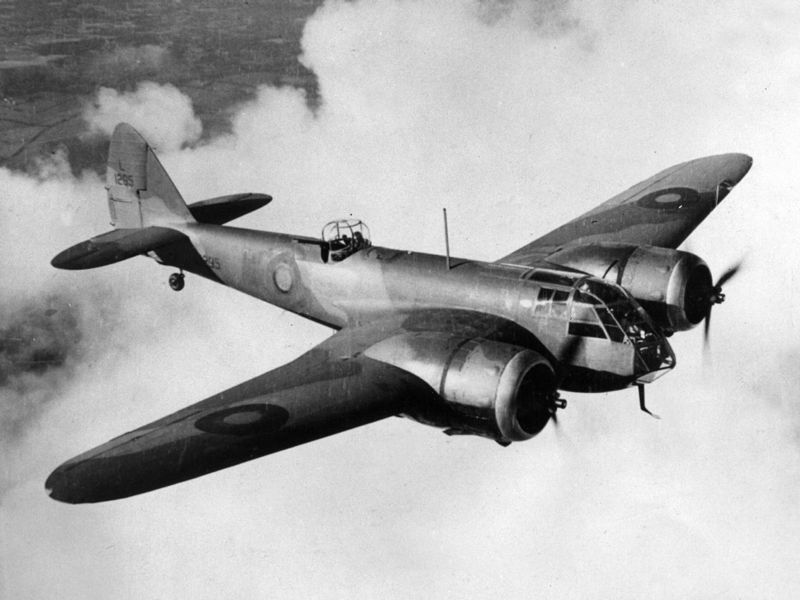 Bristol Blenheim - Photo du site wikimedia.orgBlenheim sur Béthune (62) |
|
| Localisation | Près de Lumbres - 11 km N de Fauquembergues |
|---|---|
| Circonstances | Abattu par la flak à 15000 pieds - Appareil évacué en parachute - Vers 19h40 |
| Commentaires | Décollage 18h40 de North Weald, Essex UK - A noter que le pilote indique Lambres mais se pose dans une forêt près d'une voie ferrée: il doit donc s'agir de Lumbres |
| Sources ** | D.Lautridou (source: www.bbm.org.uk) / CielDeGloire / Conscript-Heroes / Jean-Luc Maillet |
| Historique | 24/04/2014=Modif mission,comm avion,comm pil - 01/10/2017=Modif circonst - 20/09/2026=Ajout comm équip |
| Grade | Prenom | Nom | Poste | Corps | Etat |
Lieu d'Inhumation |
Commentaires |
|---|---|---|---|---|---|---|---|
| F/Lt | Frederick William 'Taffy' | Higginson | Pil | RAF | Evadé | 44630 - 28 ans - Né le 17/02/1913 Swansea, Wales (UK) – Fils de Frank K et Emily (Wyatt) Higginson - Conjoint de Jennie Jenkins - Se pose dans un bois près d'une voie ferrée (O de Lambres) - Arrêté par motocyclistes allemands, mais leur fausse compagnie - Arrêté par la police de Vichy en tentant le passage des Pyrénées en août 1941 - Evadé du Fort de la Revere (06) au printemps 1942 - Retour UK par Evacuation de 24 échappés et évadés par le bateau Seawolf depuis Le Canet-Plage (66) vers Gibraltar nuit du 21-22/09/1942Op. Titania - Retour UK 05/10/1942 - Rapport WO 208/3310/872 - †2003 |
| Fiche tech | Correspondance grades | Abréviations utilisées | Filières d'évasion | Camps de Pow | Bases RAF/USAAF | Utilitaires |
|---|
|
Rapport F/Lt Higginson: - ( I took off from NORTH WEALD on 17 Jun 41 at 1900 hrs in a Hurricane aircraft, escorting bombers whose objective was near LILLE. My position was among the second level of escorting aircraft above the bombers. The target was bombed, but on our return the Polish escort which was ahead of me disappeared and I was hit by flak East of DUNKIRK at a height of 15000 feet. I baled out and came down at about 1940 hrs, guiding the parachute into a forest near a railway. The parachute stuck in a tree, and I made off towards the railway. From my map I judged myself to be about 20 kms N.W. of FAUQUEMBERGUES, OCCUPIED FRANCE, and in the district of LAMBRES which lay to the East of me. I had only one boot and before long I unexpectedly ran into two German motor cyclists on a combination machine. They took me prisoner and carried me along the road with them. As they went along, an enemy plane swooped down above us, and the driver of the combination on which I had been placed followed the plane with his eyes. As he did so, I grasped the handlebars and wrenched them to the right, thereby forcing the motor cycle into the ditch and rendering both my captors unconscious, if not actually dead. I escaped unhurt and ran back into the forest. Before long I found some tall grass near a hut, in which I hid and watched. At about 2130 hrs I saw a tall dark man who spoke French, approach the hut. I declared my identity to him and he told me he would fetch a man who spoke English. I waited until 2300 hrs and then decided to move on. I had only gone half a kilometre when I met him again on the road, accompanied by a Frenchman who had brought civilian clothes for me. He had, however, brought no shoes and I still had only one boot. I then left my helpers, and on 18 Jun, having walked through the night across country, I reached FAUQUEMBERGUES at 1000 hrs. I entered the cafe on the far side of the village and asked for "un demi-bock". For this I offered a hundred franc note. I continued my journey for about 200 yds, when I saw some Hun cars approaching me, (they looked like G.A.F. staff cars). I, therefore, hid in a ditch for half an hour, and I then noticed a French lorry drive up and down the road past me several times. Finally, the driver opened his door and as he passed I houted "hey da". He answered "oui", and I jumped in. He then said "You're English ?", and we returned at once to a garage by the same cafe in FAUQUEMBERGUES. This cafe is the last on the right hand side of the HESDIN road, about 100 yds out of the town, and the proprietor has since been caught. My helper gave me food and general good treatment. Through an English speaking friend of his, I was put in contact with an organisation on 19 Jun by means of which I was brought back to the U.K. Original) - ( PARTIE I - WO 208/3310/872 - Source : Nat Arch UK - Traduction Ph Laroyenne): J'ai décollé de North Weald le 17 juin 1941 à 19 h 00 à bord d'un Hurricane, pour escorter des bombardiers dont l'objectif se trouvait près de Lille. Je volais au sein du deuxième échelon d'escorte, au-dessus des bombardiers. L'objectif fut bombardé, mais sur le chemin du retour, le groupe d'escorte polonais qui me précédait disparut ; je fus alors touché par la Flak à l'est de Dunkerque, à une altitude de 15 000 pieds. J'ai sauté en parachute et atterri vers 19 h 40, en dirigeant ma descente vers une forêt proche d'une voie ferrée. Mon parachute s'étant accroché dans un arbre, je me suis dirigé vers la voie ferrée. D'après ma carte, j'estimais me trouver à environ 20 km au nord-ouest de Fauquembergues, en zone occupée, et près de la localité de Lambres, [Lumbres ?] située à l'est de ma position. Je n'avais qu'une seule botte et, peu après, je suis tombé par hasard sur deux motocyclistes allemands circulant sur une moto avec side-car. Ils m'ont fait prisonnier et m'ont emmené avec eux sur la route. En chemin, un avion ennemi a piqué au-dessus de nous ; le conducteur de la moto sur laquelle j'avais pris place a suivi l'appareil du regard. J'en ai profité pour saisir le guidon et le braquer brusquement vers la droite, précipitant ainsi la moto dans le fossé et rendant mes deux ravisseurs inconscients, voire morts. Je m'en suis sorti indemne et ai couru me réfugier dans la forêt. Peu de temps après, j'ai trouvé des hautes herbes près d'une cabane ; je m'y suis caché pour observer les environs. Vers 21 h 30, j'ai vu un homme grand et brun, parlant français, s'approcher de la cabane. Je lui ai décliné mon identité et il m'a dit qu'il allait chercher quelqu'un parlant anglais. J'ai attendu jusqu'à 23 h 00 avant de décider de reprendre ma route. Je n'avais parcouru qu'un demi-kilomètre lorsque je l'ai retrouvé sur la route, accompagné d'un Français venu m'apporter des vêtements civils. Il n'avait cependant pas apporté de chaussures, et je n'avais toujours qu'une seule botte. J'ai alors quitté ceux qui m'avaient aidé et, après avoir marché toute la nuit à travers champs, j'ai atteint Fauquembergues le 18 juin à 10 h 00. Je suis entré dans le café situé à l'autre bout du village et j'ai demandé « un demi-bock ». Pour payer, j'ai tendu un billet de cent francs. J'ai poursuivi ma route sur environ 200 yards (environ 180 mètres) lorsque j'ai vu des voitures allemandes s'approcher de moi (elles ressemblaient à des voitures d'état-major de la Luftwaffe). Je me suis alors caché dans un fossé pendant une demi-heure ; j'ai ensuite remarqué un camion français qui faisait des allers-retours sur la route devant moi. Finalement, le chauffeur a ouvert sa portière et, alors qu'il passait à ma hauteur, j'ai crié « Hé ! ». Il a répondu « Oui » et je suis monté à bord. Il m'a alors demandé : « Vous êtes Anglais ? », et nous sommes immédiatement retournés à un garage situé près du même café, à Fauquembergues [Il doit s’agir du garage de Mr Paul Lefebvre, rue de Fruges) . Ce café est le dernier sur la droite en sortant de la ville par la route d'Hesdin ; le patron a été arrêté depuis lors. L'homme qui m'a aidé m'a donné à manger et m'a très bien traité. Par l'intermédiaire d'un de ses amis anglophones, j'ai été mis en contact, le 19 juin, avec une organisation qui a permis mon rapatriement au Royaume-Uni. Rapport F/Lt Higginson e: - ( APPENDIX C - On 19 Jun 41 at 0700 hrs DIDRI came in a car to fetch me from FAUQUEMBERGUES. He drove me via HESDIN to ABBEVILLE. On arrival in ABBEVILLE we went to a French Roman Catholic padre , whose name is CARPENTIER, (now in Prison) who said he could not help because I had no papers ; DIDRI therefore drove me back to ST. OMER where I stayed for one night in his hardware shop. On 20 Jun 41 he took me out on foot on to the LILLE road, and we hid in a big lorry which was waiting for us. We drove in this lorry to LILLE, where we got out and met a man who took us to a cafe. Very soon a Mr. PAUL came in and took us to a butcher's shop. I stayed eight days in M. Paul's flat and during that time I got an identity card. On 29 jun 41 I went again to ABBEVILLE and saw CARPENTIER, who gave me his own laisser passer with which I crossed the SOMME without difficulty, entering a cafe on the other side. The cafe proprietor took my laisser passer back from me. I then took the train to PARIS at 1600 hrs, travelling first class and experiencing no difficulties. I was accompanied by PAUL, who fixed me up with the proprietor of a Hotel de Reception. I stayed in PARIS for two nights taking my meals at the cafe du PONT NEUF. The food at this cafe was excellent and I sampled eggs and chicken obtained through the Black Market. On one occasion a German, sitting at the next table, asked in irritation 'why can't we have chicken ?". The waiter retorted that I had brought the food from the country myself. On 1 Jul we took a train to TOURS and then on to St. MARTIN-LE-BEAU. Here we missed a pre-arranged contact with a girl at the post office. We therefore walked along the river until we saw a lady with a boat. She towed us across and we walked on to a main road. Very soon we were met by two German soldiers (an officer and a sergeant). When questioned PAUL said, "he is an idiot" ("un fou") looking for work". We were asked for identity cards. PAUL produced cards and argued volubly. The German sergeant then tackled me. I showed my card and the officer said, "it's a good card, now open your valise". It so happened that my valise was full of chocolate that had melted in the heat and spread itself over the contents. This was enough for the German officer. PAUL then opened his valise which contained both special papers and a revolver which he managed to conceal in some dirty laundry. The soldiers never spotted these articles and said "Allez". Throughout this episode I was impressed by PAUL's ingenuity. For six or seven hours we hid in a forest near a farm with which PAUL had several contacts. At 2100 hrs we answered the signal of a boy who was acting as liaison between PAUL and the farm, and we were at once helped over the river. Original) - ( PARTIE II): ANNEXE C – Le 19 juin 1941, à 7 heures du matin, Désiré Didry est venu me chercher en voiture à Fauquembergues [Sera arrêté par la Gestapo et déporté en Août 1942 – Exécuté le 30/06/43 à Dortmunt]. Il m'a conduit jusqu'à Abbeville en passant par Hesdin. À notre arrivée à Abbeville, nous sommes allés voir un prêtre catholique français nommé Carpentier (aujourd'hui en prison) ; il a déclaré ne pas pouvoir m'aider car je n'avais pas de papiers. Didry m'a donc ramené à St-Omer, où j'ai passé la nuit dans sa quincaillerie. Le 20 juin 1941, il m'a emmené à pied sur la route de Lille et nous nous sommes cachés dans un gros camion qui nous attendait. Nous avons rejoint Lille en camion ; une fois sur place, nous sommes descendus et avons rencontré un homme qui nous a conduits dans un café. Peu après, un certain Mr Paul est arrivé et nous a emmenés dans une boucherie. J'ai séjourné huit jours dans l'appartement de Mr Paul ; durant cette période, j'ai obtenu une carte d'identité. Le 29 juin 1941, je me suis rendu de nouveau à Abbeville et j'ai vu Carpentier ; il m'a remis son propre laissez-passer, grâce auquel j'ai traversé la Somme sans difficulté pour entrer dans un café situé de l'autre côté. Le patron du café m'a repris mon laissez-passer. J'ai ensuite pris le train pour Paris à 16 heures, voyageant en première classe sans le moindre problème. J'étais accompagné de Paul, qui m'a mis en contact avec le gérant d'un hôtel d'accueil. J'ai séjourné deux nuits à Paris, prenant mes repas au café du Pont-Neuf. La cuisine y était excellente ; j'y ai goûté des œufs et du poulet provenant du marché noir. Une fois, un Allemand assis à la table voisine a demandé avec irritation : « Pourquoi ne pouvons-nous pas avoir de poulet ? » Le serveur a rétorqué que j'avais moi-même apporté ces aliments de la campagne. Le 1er juillet, nous avons pris le train pour Tours, puis pour Saint-Martin-le-Beau. Là-bas, nous avons manqué le rendez-vous prévu avec une jeune femme au bureau de poste. Nous avons donc longé la rivière jusqu'à apercevoir une dame avec une barque. Elle nous a fait traverser en nous remorquant, et nous avons rejoint une route principale. Peu après, nous sommes tombés sur deux soldats allemands (un officier et un sergent). Lorsqu'on l'a interrogé, Paul a répondu : « C'est un idiot » (« un fou ») « qui cherche du travail ». On nous a demandé nos cartes d'identité. Paul a présenté des cartes et a discuté avec volubilité. Le sergent allemand s'est ensuite adressé à moi. J'ai montré ma carte et l'officier a dit : « C'est une bonne carte ; maintenant, ouvrez votre valise. » Il se trouvait que ma valise était remplie de chocolat qui avait fondu sous l'effet de la chaleur et s'était répandu sur tout le contenu. Cela suffit à l'officier allemand. Paul ouvrit alors sa valise, qui contenait des documents spéciaux ainsi qu'un revolver qu'il parvint à dissimuler dans du linge sale. Les soldats ne remarquèrent rien et dirent : « Allez ». Tout au long de cet épisode, je fus impressionné par l'ingéniosité de Paul. Nous restâmes cachés pendant six ou sept heures dans une forêt, près d'une ferme avec laquelle Paul entretenait plusieurs contacts. À 21 heures, nous répondîmes au signal d'un garçon servant d'agent de liaison entre Paul et la ferme ; on nous aida aussitôt à traverser la rivière. Rapport F/Lt Higginson: - ( At 2300 hrs we set off to walk across the Line of Demarcation, continuing for two hours to another farm. After resting for a short time we walked another 30 Km along the main road to LOCHES. From here we took a train to CHATEAUROUX (2 Jul) and then on to MARSEILLES. At CHATEAUROUX station I saw from 10 to 15 French workmen about to depart for GERMANY ; they all appeared remarkly happy. At MARSEILLES we stayed two days at the house of a Greek doctor where I met the following people : Capt. Ian GARRON, Patrick O'LEARY, LALONDE (?) (now in ENGLAND), Mr. KENNY (now in Paris), Mrs. Elisabeth HAYDEN-GUEST and an Australian, Cpl. MASON. On 4 Jul I left for PERPIGNAN by train with KENNY, LALONDE and a Father DICKINSON. Here we were handed over to a Spanish guide, intending to stay for ten days at the hotel REGINA. However, at the end of the period nothing happened and by 16 Jul I had no money left, though Paul had given me a little extra during our journey. On my way to the station I saw MASON and he took me back to the hotel de la LOGE, where we spoke to our guide urging him to take action. Our efforts resulted in our leaving PERPIGNAN that day for BANYULS-sur-MER. At this place we showed our papers to a gendarme who took DICKINSON and myself to a police station. DICKINSON was caught ; I might have get away but I struck the officer and got put in jail for six monts on the charge of having a false identity card, DICKINSON having apparently given me away. I was taken to PORT VENDRES prison, where the conditions where bad then on to PERPIGNAN, where they were worse. I actually lost 15 Kilo while in prison at PERPIGNAN. On 5 Sep I was transferred to the military prison at MONTPELLIER. Here I met Pte MUMME (S/P.G.(B) 650), who gave himself out to be a lieutenant though I believe him to be a private soldier. On 23 Sep I was sent to the civil prison and at this time MUMME got away. Conditions in the latter two prisons were better. On 25 Oct I was 'gracie" and sent to ST. HIPPOLYTE. On 17 Jan 42 we were given notice that we were to be free, but it was not until 3 Mar that the Consulate arranged for our exit visas to SPAIN. On 5 Mar, 52 of us left for PERPIGNAN, expecting to be freed ; but as a reprisal for the raid on the RENAULT works in FRANCE we were sent back to ST. HIPPOLYTE until 17 Mar 42, when we were moved to FORT DE LA REVERE. I remained here several months planning various methods of escape. Finally, about 18 Aug we heard that the officers were leaving the camp for LYONS, so I, in company with F/Lt. HARNETT, F/O HAWKINS and Sgts. NABARRO and HICKTON decided to take a chance on a method which had previously seemed too risky. On the night of 23 Aug 42 we escaped. Original) - ( PARTIE III): À 23 heures, nous nous mîmes en route pour franchir la ligne de démarcation, marchant pendant deux heures jusqu'à une autre ferme. Après un court repos, nous parcourûmes encore 30 kilomètres le long de la route principale en direction de Loches. De là, nous prîmes le train pour Châteauroux (le 2 juillet), puis pour Marseille. À la gare de Châteauroux, j'aperçus une dizaine ou une quinzaine d'ouvriers français sur le point de partir pour l'Allemagne ; ils semblaient tous remarquablement heureux. À Marseille, nous séjournâmes deux jours chez un médecin grec [ Dr George Rodocanachi - Mort en déportation le 11/02/1944 à Buchenwald - Fiches Arolsen n°39580] ; j'y rencontrai les personnes suivantes : le capitaine Ian Garron, Patrick O'Leary, Lalonde (?) (aujourd'hui en Angleterre), Mr Kenny (aujourd'hui à Paris), Mme Elisabeth Hayden-Guest et un Australien, le caporal Mason. Le 4 juillet, je partis pour Perpignan en train avec Kenny, Lalonde et le père Dickinson. Sur place, nous fûmes confiés à un guide espagnol et devions séjourner dix jours à l'hôtel Regina. Toutefois, ce délai écoulé, rien ne s'était passé ; au 16 juillet, je n'avais plus d'argent, bien que Paul m'en eût donné un peu plus au cours de notre trajet. En me rendant à la gare, je croisai Mason ; il m'emmena à l'hôtel de la Loge, où nous exhortâmes notre guide à agir. Nos démarches aboutirent à notre départ de Perpignan ce jour-là pour Banyuls-sur-Mer. Là, nous présentâmes nos papiers à un gendarme qui conduisit Dickinson et moi-même au poste de police. Dickinson fut arrêté ; J'aurais peut-être pu m'échapper, mais j'ai frappé l'officier et me suis retrouvé en prison pour six mois, accusé de détenir une fausse carte d'identité ; Dickinson m'avait apparemment dénoncé. J'ai d'abord été conduit à la prison de Port-Vendres, où les conditions étaient mauvaises, puis à celle de Perpignan, où elles étaient pires encore. J'ai d'ailleurs perdu 15 kilos durant mon incarcération à Perpignan. Le 5 septembre, j'ai été transféré à la prison militaire de Montpellier. C'est là que j'ai rencontré le soldat Mumme (S/P.G.(B) 650), qui se faisait passer pour un lieutenant, bien que je le crusse être un simple soldat. Le 23 septembre, j'ai été envoyé à la prison civile ; c'est à ce moment-là que Mumme s'est évadé. Les conditions de détention étaient meilleures dans ces deux derniers établissements. Le 25 octobre, j'ai été transféré à Saint-Hippolyte. Le 17 janvier 1942, nous avons été informés de notre libération prochaine, mais ce n'est que le 3 mars que le consulat a obtenu nos visas de sortie pour l'Espagne. Le 5 mars, nous sommes partis à 52 pour Perpignan, dans l'espoir d'être libérés ; toutefois, en représailles au raid aérien sur les usines Renault en France, nous avons été renvoyés à Saint-Hippolyte jusqu'au 17 mars 1942, date à laquelle nous avons été transférés au Fort de la Revere [06]. J'y suis resté plusieurs mois, envisageant divers moyens de nous évader. Finalement, vers le 18 août, nous avons appris que les officiers quittaient le camp pour Lyon ; j'ai donc décidé, en compagnie du F/Lt Harnett, du F/O Hawkins et des Sgts Nabarro et Hickton, de tenter le tout pour le tout avec une méthode qui nous avait semblé trop risquée auparavant. Nous nous sommes évadés dans la nuit du 23 août 1942. Rapport F/Lt Higginson: - ( From our room there was a coal shute down into the kitchen which was locked, barred and wired. Sgt. DALPHOND (S/P.G.(-) 907) made a key for the lock and at 2215 hrs we crawled through the wire. After breaking three bars across the window we let ourselves down into the moat from the kitchen, which we knew to be empty, by means of a rope which we had made ourselves. From the moat we got through a sewer which led us beyond the bounds of the Fort, having to cut another bar at the far end. This took us until about 2340 hrs. In order to cover the noise that we made, a concert had been organised. Within ten minutes of our escape, it was discovered. We saw the lights go on and we ran like hell towards Monte Carlo where we had an address to which to go. I had three contacts, while in the Fort : (1) a Polish padre MIDAR (?), (2) Val, a Russian who paid regular visits to the Fort and to whom we confided most our plans, (3) Mrs. THOMAS, a Frenchwoman, wife of one of the British soldiers in the Fort. For the occasion of our escape I had chosen the two N.C.Os, NABARRO and HICKTON to came with me. I had previously notified the organisation outside the Fort to make all necessary preparations ; and VAL had informed us that he would set us when we got out of the camp with two other guides, FRIEND (an Australian inspector of police, who was under suspicion when we left) and JACQUES ( a man with one eye, who has since been caught, and is in prison with GASTON NEGRE). Unfortunately, we missed these guides, we were caught by the guards when they were chasing us, and their names were taken. We arrived at a place which we thought was MONTE CARLO, but we could not get our bearings ; we, therefore, decided to wait till morning, when we found that we were in CAP D'AIL. I had lost my identity card in the escape, so we decided to send F/O HAWKINS (S/P.G.(-) 879) who had a good one, to MONTE CARLO in order to make our pre-arranged contacts. HAWKINS succeeded in doing this and the organisation picked us up during the afternoon (24 Aug 42). We were taken to MONTE CARLO and hidden in a flat which belongs to a Mr. TURNER, a London hairdresser, who is unaware that his flat is being used in this way. The food here was first class, and we were given new identity cards. We were looked after very well by Mme GUITON. On 2 Sep I left Monte Carlo, disguised as a cure, in company with MIRDIR (?) and Sgt. KICKTON (S/P.G.(-) 894). We went to MARSEILLES, and stayed at Mme NOUVEAU's flat on the water front. On 17 Sep I left with F/O Hawkins for PERPIGNAN and CANET PLAGE. We were picked up by a Polish fishing smack on 20 Sep, from which we were transferred to H.M.S. MINNA in the région of the BALEARES Islands and taken to GIBRALTAR. At this time I travelled under the name of Capt. BENNETT, R.A.S.C. I left GIBRALTAR for the U.K. on 30 Sept 42.Original) - ( PARTIE IV): Depuis notre chambre, une trémie à charbon descendait vers la cuisine, mais l'accès était verrouillé, grillagé et barré de barreaux métalliques. Le Sgt Dalphond (PoW n° 907) a fabriqué une clé pour la serrure et, à 22 h 15, nous nous sommes glissés à travers le grillage. Après avoir brisé trois barreaux de la fenêtre, nous sommes descendus dans les douves depuis la cuisine — dont nous savions qu'elle était vide — à l'aide d'une corde que nous avions confectionnée nous-mêmes. Depuis les douves, nous avons emprunté un égout qui nous a conduits au-delà de l'enceinte du fort, après avoir dû couper un autre barreau à l'extrémité du conduit. Cette opération nous a pris jusqu'à environ 23 h 40. Un concert avait été organisé pour couvrir le bruit que nous faisions. Notre évasion a été découverte dix minutes seulement après notre départ. Nous avons vu les lumières s'allumer et nous avons couru à toutes jambes vers Monte-Carlo, où nous avions une adresse de destination. Pendant mon séjour au Fort, j'avais trois contacts : (1) un aumônier polonais nommé Midar (?), (2) Val, un Russe qui se rendait régulièrement au Fort et à qui nous confiions la plupart de nos projets, et (3) Mme Thomas, une Française, épouse de l'un des soldats britanniques présents au Fort. Pour notre évasion, j'avais choisi deux Non Commissioned Officer (Sous-Officier)N.C.Os, Nabarro et Hickton, pour m'accompagner. J'avais prévenu l'organisation à l'extérieur du fort afin que toutes les dispositions nécessaires soient prises ; Val nous avait indiqué qu'à notre sortie du camp, nous retrouverions deux autres guides : Friend (un inspecteur de police australien, qui était sous surveillance au moment de notre départ) et Jacques (un homme borgne, capturé depuis lors et actuellement emprisonné aux côtés de Gaston Nègre). Malheureusement, nous avons manqué ces guides ; les gardes nous ont rattrapés alors qu'ils nous prenaient en chasse et ont relevé nos identités. Nous sommes arrivés dans un lieu que nous pensions être Monte-Carlo, mais nous n'arrivions pas à nous situer ; nous avons donc décidé d'attendre le matin, moment où nous avons découvert que nous nous trouvions à Cap-d'Ail. Ayant perdu ma carte d'identité lors de l'évasion, nous avons décidé d'envoyer le F/O Hawkins (S/P.G.(-) 879) — qui en possédait une en règle — à Monte-Carlo pour établir les contacts prévus. Hawkins a réussi sa mission et l'organisation nous a pris en charge dans l'après-midi du 24 août 1942. Nous avons été conduits à Monte-Carlo et cachés dans un appartement appartenant à un certain Mr Turner, un coiffeur londonien qui ignorait que son logement servait à cette fin. La nourriture y était excellente et nous avons reçu de nouvelles cartes d'identité. Mme Guiton a pris grand soin de nous. Le 2 septembre, j'ai quitté Monte-Carlo, déguisé en ecclésiastique, en compagnie de Mirdir (?) et du sergent Hickton (S/P.G.(-) 894). Nous nous sommes rendus à Marseille et avons séjourné dans l'appartement de Mme Nouveau, situé en bord de mer. Le 17 septembre, je suis parti avec le F/O Hawkins pour Perpignan et Canet-Plage. Le 20 septembre, nous avons été récupérés par un bateau de pêche polonais, puis transférés à bord du HMS Minna au large des îles Baléares avant d'être conduits à Gibraltar. À cette époque, je voyageais sous l'identité du capitaine Bennett (R.A.S.C.). J'ai quitté Gibraltar pour le Royaume-Uni le 30 septembre 1942. Page sur P/O Higginson sur www.bbm.org.uk (Lien communiqué par Dominique Lautridou) Article et photo F W Higginson sur www.gowertonian-society.co.uk Article sur Higginson sur en.wikipedia.org Article sur l'opération Titania sur www.conscript-heroes.com Page sur les évasions du Fort de la Revère sur sudwall.superforum.fr (Lien transmis par Jean-Luc Maillet) |