|
Crash - Halifax - type II - s/n JB872 EY°Q |

|
|
|
Crash - Halifax - type II - s/n JB872 EY°Q |
|
| Fiche France-Crashes 39-45 modifiée le 21-04-2026 | |||||
| Date | Nation |
 Département Département |
Unité | - | Mission |
|---|---|---|---|---|---|
| 06-09-1943 | Angleterre/Common. | Marne | 78 Sq RAF | Mannheim (All) - Zone Ind et de Stockage | |
| Localisation | St-Hilaire-le-Grand - 7 km NW Suippes |
|---|---|
| Circonstances | Touché par chasseur de nuit a l'aller - Avarie moteur au retour (tombe en vrille) - 19h33 |
| Commentaires | Décollage de Breighton, Yorkshire UK à 19h33 |
| Sources ** |
ANSA (source: Listes des bombardiers et équipages perdus: Royal Air Force - Bomber Command Losses of the Second World War par WR Listes des bombardiers et équipages perdus: Royal Air Force - Bomber Command Losses of the Second World War par WR Chorley WR Chorley) / CWGC |
| Historique | 26/06/2013=Ajout comm Ebeling - 04/04/2018=Ajout comm Bomb - 21/04/2026=Ajout comm Pil et Mec,rapport |
| Grade | Prenom | Nom | Poste | Corps | Etat |
Lieu d'Inhumation |
Commentaires |
|---|---|---|---|---|---|---|---|
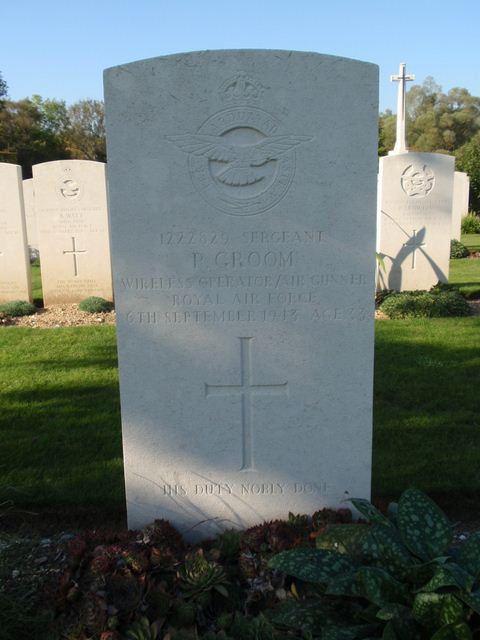
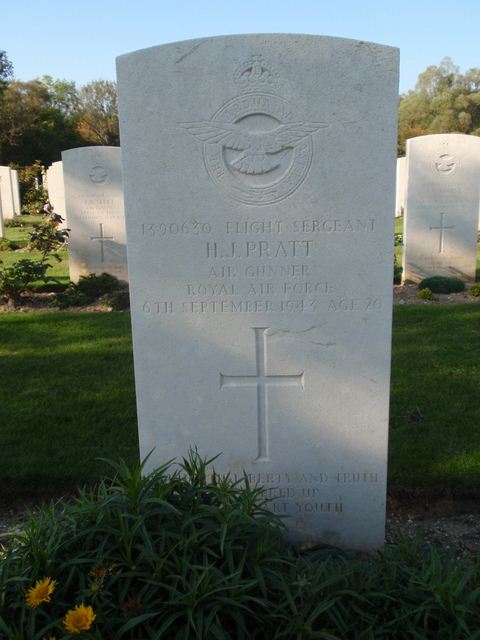
| F/Sgt | Henry John | Pratt | MitA | RAF VR | Décédé | Cim Mil Choloy (54) - Plan - TJ 2E1-7 * | 1390630 - 20 ans - Fils de Thomas Edward et Rebecca Mary Pratt, de Mile End, London |
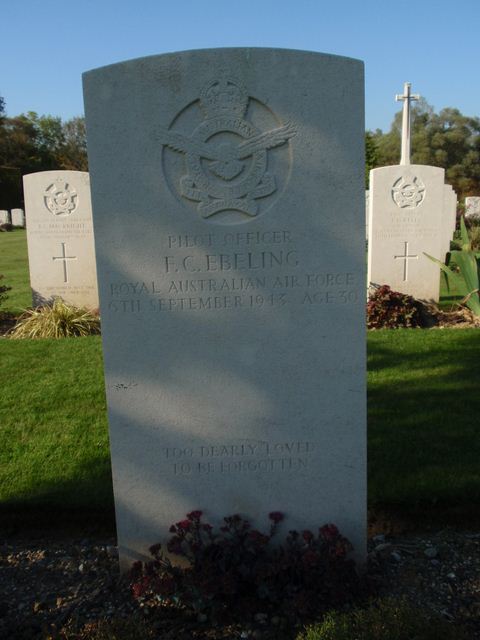
| P/O | Frederick Clive | Ebeling | Pil | RAAF | Décédé | Cim Mil Choloy (54) - Plan - TJ 2E1-7 * | AUS 414129 - 30 ans - Né le 02/10/1912 à Mullumbimby, NSW - Fils de Henry Frederick et Mary Ethel Ebeling; conjoint de Beryl Ebeling, de Casino, New South Wales, Australia. |
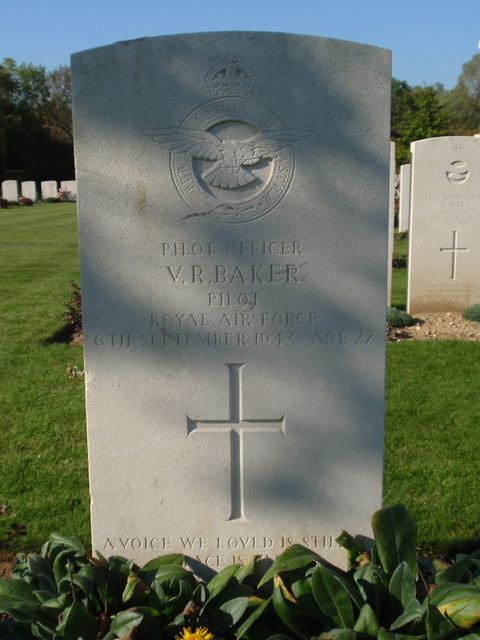
| P/O | Vernon Reginald | Baker | Pass | RAF VR | Décédé | Cim Mil Choloy (54) - Plan - TJ 2E1-7 * | 156698 - 22 ans - Fils de Reginald Ernest et Alice Maud Baker, de Downham, Kent |
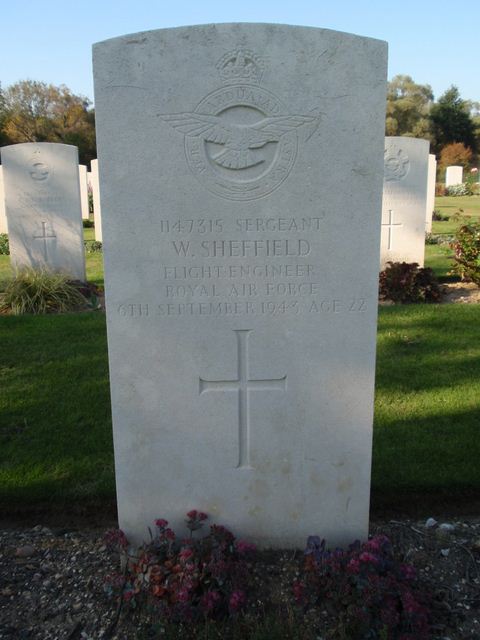
| Sgt | William | Sheffield | Mec | RAF VR | Décédé | Cim Mil Choloy (54) - Plan - TJ 2E1-7 * | 1147315 - 22 ans - Fils de William et Rebbecca Sheffield, de Newcastle-on-Tyne |
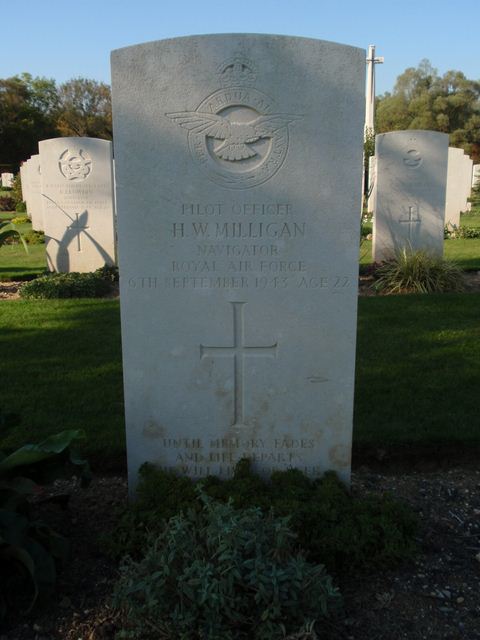
| P/O | Henry William | Milligan | Nav | RAF VR | Décédé | Cim Mil Choloy (54) - Plan - TJ 2E1-7 * | 156006 - 22 ans - Fils de Henry et Ellen Milligan, de Stepney, London |
| Sgt | Hubert | Salter | Bomb | RAF | Echappé | 1318641 - Né le 21/06/1910 - Seul rescapé - Retour UK 06/02/44 - Rapport WO 208/3318/1748 | |
| Sgt | Philip | Groom | R/Mit | RAF VR | Décédé | Cim Mil Choloy (54) - Plan - TJ 2E1-7 * | 1222829 - 33 ans - Fils de Francis John et Sarah Annie Groom; conjoint de Ester May Groom, de Hednesford, Staffordshire |
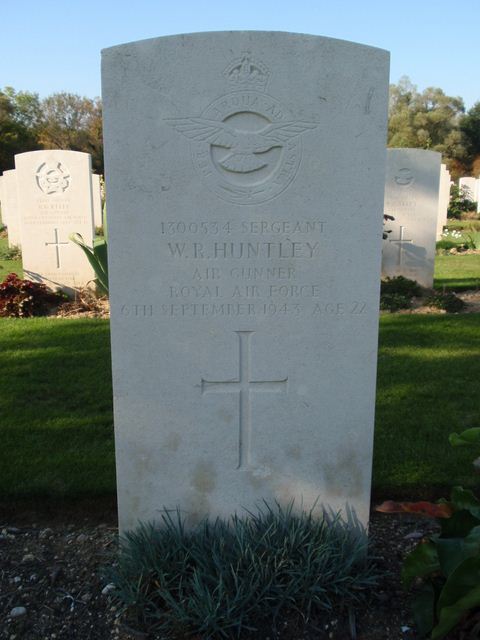
| Sgt | Walter Roy | Huntley | MitS | RAF VR | Décédé | Cim Mil Choloy (54) - Plan - TJ 2E1-7 * | 1300534 - 22 ans - Fils de Walter James Huntley et Annie Eleanor Huntley; conjoint de Janet Lilian Sara Huntley, de York |
| Fiche tech | Correspondance grades | Abréviations utilisées | Filières d'évasion | Camps de Pow | Bases RAF/USAAF | Utilitaires |
|---|
|
Rapport Sgt Salter: - ( I took off from BREIGHTON about 1930 hrs. On 5 Sep 43 in a Halifax aircraft to bomb MANNHEIM. We reached our target but while over the target area we were shot up by a fighter and our petrol tanks were hit. About an hour later the pilot gave the order to bale out. I came down somewhere in the woods South of PONT-FAVERGER (N.W. EUROPE, 1:250,000, Sheet 8, T 5284). I landed about 50 yards from the aircraft and after hiding my flying kit and parachute I made off as quickly as I could away from the site of the crash. I had lost a boot in baling out and walking was difficult. After going for about five miles I rested and then went on a little further. I remained in hiding all the next day (6 Sep) and the following day I went to a farmhouse and asked for help. This man was a Pole and did not speak a word of English. I made him understand who I was and he gave some overall trousers, a civilian jacket and one boot. I then set off walking again. I passed through ST. HILAIRE-LE-GRAND (Sheet 8, T 6269) and when I was on the outskirts of this village I was stopped by a policeman. I cannot remember any details about this man's uniform but it seemed to me quite different from the uniform that the French police usually wear. It was light blue in color. I thought he might probably be a member of the PETAIN police. He took me to a nearby house, made a note of my name and number and then went out and locked the front door. After he had gone I found that he had left the back door open so I went out by that way. I walked through SUIPPES (Sheet 9, T 6764) and then across country to VITRY-LE-FRANCOIS (Sheet 9, T 21) I reached this town on 12 Sep. During my journey I used to stop at farmhouse and ask for water once or twice a day. I was frequently given food in addition to something to drink but no one was very helpful. At night I slept in barns. I must have looked very ragged and unkempt when I reached VITRY-LE-FRANCOIS because I had no shaved for about a week. I was stopped in the town by a Belgian who seemed to know at once who I was. This man spoke English and took me back with him to his house. I remained with him until 17 Sep. While I was here he gave me an identity card using one of my issue photographs. I was then taken to a farm about ten miles due West of VITRY-LE-FRANCOIS where I remained for two days. I do not know the name or address of this helper. At the end of this time my first helper came to fetch me with a Frenchman and we all cycled to TRECON (Sheet 8, T 3336). On the way there I was stopped by two German policeman at a picket post at SOUDRAN (Sheet 8, T 4133). My two helpers were cycling on ahead of me and did not see what happened. The Germans asked me to produce my papers which I did. They then went through my pockets.Original) - ( PARTIE I - WO 208/3318/1748 - Source : Nat Arch UK - Traduction Ph Laroyenne): J'ai décollé de Breighton vers 19h30 le 5 septembre 1943 à bord d'un Halifax pour bombarder Mannheim. Nous avons atteint notre cible, mais au-dessus de la zone visée, nous avons été pris pour cible par un chasseur et nos réservoirs d'essence ont été touchés. Environ une heure plus tard, le pilote a donné l'ordre de sauter en parachute. J'ai atterri quelque part dans les bois au sud de Pontfaverger (N.W. EUROPE, 1:250,000, Feuille 8, vT5284). J'ai atterri à une cinquantaine de mètres de l'avion et, après avoir caché mon équipement de vol et mon parachute, je me suis éloigné aussi vite que possible du lieu du crash. J'avais perdu une botte en sautant et marcher était difficile. Après avoir parcouru environ huit kilomètres, je me suis reposé, puis j'ai continué un peu plus loin. Je suis resté caché toute la journée suivante (6 septembre) et le jour suivant, je suis allé dans une ferme et j'ai demandé de l'aide. Cet homme était polonais et ne parlait pas un mot d'anglais. Je lui ai fait comprendre qui j'étais et il m'a donné un pantalon de salopette, une veste civile et une botte. Je suis ensuite reparti à pied. J'ai traversé Saint-Hilaire-le-Grand (vT6269) et, à la sortie du village, un policier m'a interpellé. Je ne me souviens plus des détails de son uniforme, mais il me semblait assez différent de celui de la police française. Il était bleu clair. J'ai pensé qu'il appartenait probablement à la police de Pétain. Il m'a conduit à une maison voisine, a noté mon nom et mon numéro, puis est sorti et a verrouillé la porte d'entrée. Après son départ, j'ai constaté qu'il avait laissé la porte de derrière ouverte et je suis sorti par là. J'ai traversé Suippes (Feuille 9, vT6764), puis la campagne jusqu'à Vitry-le-François (vT6919), où je suis arrivé le 12 septembre. Durant mon voyage, je m'arrêtais dans les fermes une ou deux fois par jour pour demander de l'eau. On me donnait souvent à manger et à boire, mais personne n'était vraiment serviable. La nuit, je dormais dans des granges. Je devais avoir l'air très négligé et débraillé en arrivant à Vitry-le-François, car je ne m'étais pas rasé depuis une semaine. Un Belge m'a interpellé en ville et a semblé me reconnaître immédiatement. Cet homme parlait anglais et m'a emmené chez lui. Je suis resté avec lui jusqu'au 17 septembre. Pendant mon séjour, il m'a remis une carte d'identité réalisée à partir d'une de mes photos officielles. J'ai ensuite été conduit dans une ferme à une quinzaine de kilomètres à l'ouest de Vitry-le-François, où je suis resté deux jours. J'ignore le nom et l'adresse de cette personne. À la fin de cette période, mon premier protecteur est venu me chercher avec un Français et nous avons tous pédalé jusqu'à Trécon (Feuille 8, vT3336). En chemin, j'ai été arrêté par deux policiers allemands à un poste de contrôle à Soudron (vT4133). Mes deux protecteurs, qui pédalaient devant moi, n'ont rien vu. Les Allemands m'ont demandé mes papiers, ce que j'ai fait. Ils ont ensuite fouillé mes poches. Rapport Sgt Salter: - ( During this examination I acted as though I were a little silly in the head and could not talk properly. They let me go on without detaining me. I spent one night in TRECON and from this point my journey was arranged for me. APPENDIX C - In VITRY-LE-FRANCOIS (N.W. EUROPE, 1:250,000, Sheet 9, T 21) I was sheltered from 12 - 17 Sep 43 by a man whose Christian name was PIERRE. He was a Belgian, spoke English and owned a wine shop in the town. PIERRE also arranged for me to stay at a farm about ten miles away for two days. He and another Frenchman took me by bicycle to TRECON (Sheet 8, T 3336) where I spent one night with a farmer who was a member of a Resistance organisation. On 19 Sep I went to VERTUS (Sheet 8, T 2741) and stayed for the day with FAYON the leader of the resistance movement in that town. From there I was taken by car to EPERNAY (Sheet 8, T 25). I spent the first day with PIERRE SAVANACH, the leader of the resistance movement in EPERNAY. I was then taken to stay with CAMILLE ROUSSEAU, at the Cafe Marche, for a week and later I was sheltered by M. GUACHE (phonetic spelling), a member of the same organization, until the end of October. In EPERNAY I met 2/Lt. DAVIDSON and S/Sgt. KTUGER both of the U.S.A.A.F. SAVANACH arranged for us to go to PARIS where we were to be picked up by another organisation and taken to the West coast. At the end of Oct DAVIDSON, KRUGER and I were taken to the station at EPERNAY where we met several Frenchmen. We were given tickets and all caught the train to PARIS. There we met several more French people who gave us new tickets and we boarded another train for QUIMPER (W 15). At QUIMPER we were met by FOUFOU (phonetic spelling). He took us to his father's place which was a fish canning factory under German control. We were put in a flat at the top of this building. I believe there were 14 people there at the time. Some of them I know were British but I did not learn their names. After a week we were told that the operation had fallen through and we would be going back to PARIS. By this time the party had grown to 26 - half of them being British or American and the remainder French. FOUFOU is about 5 ft 7 ins tall, slimly built with delicate features. He wears glasses and speaks good English. In PARIS, DAVIDSON, KRUGER and I were met by M. GUACHE who took us back to EPERNAY. I stayed with M. GUACHE for two weeks when I was told that I would have to leave as the Gestapo had picked up some members of his organisation. I was then sent to an address where Sgt. MARSH was staying and from this point my journey is as related in Appendix C to his report.Original) - ( PARTIE II): Durant cet interrogatoire, j'ai feint d'être un peu dérangé et incapable de parler correctement. On m'a laissé partir sans me retenir. J'ai passé une nuit à Trécon, et à partir de là, mon voyage a été organisé. ANNEXE C - À Vitry-le-François, j'ai été hébergé du 12 au 17 septembre 1943 par un homme prénommé Pierre [Il pourrait s’agir de Pierre Depaep] . Belge, il parlait anglais et tenait un magasin de vins dans la ville. Pierre m'a également trouvé un hébergement dans une ferme à une quinzaine de kilomètres de là, pour deux jours. Avec un autre Français, il m'a emmené à vélo à Trécon, où j'ai passé une nuit chez un fermier membre d'un groupe résistant. Le 19 septembre, je suis allé à Vertus (vT2741) et j'ai passé la journée avec Fernand Fayon, le chef de la Résistance locale. De là, j'ai été conduit en voiture à Épernay (vT2456). J'ai passé ma première journée avec Pierre Servagnat [Son épouse, Fernande, sera déportée à Ravensbrück], le chef de la Résistance à Épernay. J'ai ensuite été hébergé une semaine chez Camille Rousseau, au Café du Marché, puis par Fernand Gauche, membre de la même organisation, jusqu'à la fin octobre. À Épernay, j'ai rencontré le 2Lt Roy C Davidson et le Sgt/C Fred Krueger, tous deux de l'USAAF [fiche]. Servagnat a organisé notre départ pour Paris, où nous devions être pris en charge par une autre organisation et conduits sur la côte Ouest. Fin octobre, Davidson, Krueger et moi avons été emmenés à la gare d'Épernay, où nous avons rencontré plusieurs Français. Ils nous ont donné des billets et nous avons pris le train pour Paris. Là, nous avons rencontré d'autres Français qui nous ont donné de nouveaux billets et nous avons embarqué dans un autre train pour Quimper (Feuille 7A&13A, vW1954). À Quimper, Foufou nous attendait. Il nous a emmenés chez son père, qui tenait une conserverie de poisson sous contrôle allemand. On nous a logés dans un appartement au dernier étage de cet immeuble. Je crois qu'il y avait 14 personnes à ce moment-là. Je sais que certains étaient britanniques, mais je n'ai pas retenu leurs noms. Au bout d'une semaine, on nous a annoncé que l'opération avait échoué et que nous devions rentrer à Paris. À ce moment-là, le groupe comptait 26 personnes : la moitié étaient britanniques ou américaines et l'autre moitié françaises. Foufou mesure environ 1,70 m, est mince et a des traits fins. Il porte des lunettes et parle bien anglais. À Paris, Davidson, Kruger et moi avons été accueillis par Mr Gauche, qui nous a ramenés à Épernay. Je suis resté chez lui pendant deux semaines, puis on m'a dit que je devais partir, car la Gestapo avait arrêté des membres de son organisation. J'ai ensuite été envoyé à l'adresse où logeait le Sgt Marsh, et à partir de là, mon voyage est relaté dans l'annexe C de son rapport.
|