|
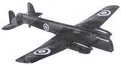
Crash - Whitley - s/n BD534 XH°? |

|
|
|
Crash - Whitley - s/n BD534 XH°? |
|
| Fiche France-Crashes 39-45 modifiée le 31-10-2023 | |||||
| Date | Nation |
 Département |
Unité | - | Mission |
|---|---|---|---|---|---|
| 18-04-1943 | Angleterre/Common. | Calvados | 296 Sq RAF – 38 group | Bombardement Station électrique ferroviaire au S de Mézidon (14) | |
| Localisation | Près d'Ernes - 7 Km S-O de Mézidon |
|---|---|
| Circonstances | Endommagé par la flak au niveau des racks à bombes, provoquant un incendie - Avion évacué partiellement en parachute -Crash vers 01h30 |
| Commentaires | Décollage 22h50 le 17/4 de Hurn, Hampshire UK |
| Sources ** | J-L Maillet (sources: CWGC / Rafcommands.com) / Richard Sobinski (source: aircrewremembered.com) / J-M Chandavoine (source: Rapport Gend) / Nat Arch UK (ORB 27-1645-1) |
| Historique | 09/04/2014=Ajout lien - 24/10/2023=Modif local/Ajout circ,infos équip - 31/10/2023=Ajout rapports |
| Grade | Prenom | Nom | Poste | Corps | Etat |
Lieu d'Inhumation |
Commentaires |
|---|---|---|---|---|---|---|---|
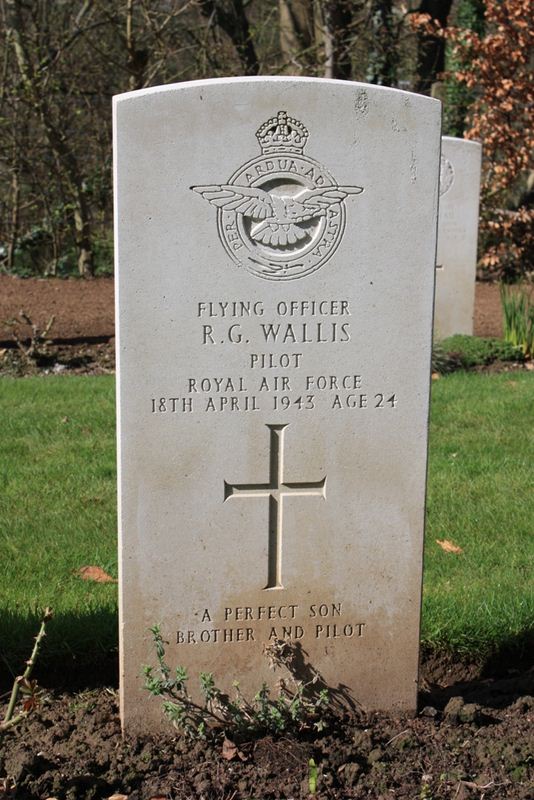
| F/O | Roger George | Wallis | Pil | RAF VR | Décédé | Cim Mil Fr-Brit St-Valéry-en-Caux (76) - Plan - B.30 * | 119823 – 24 ans – Fils de Henry George et Ettie V. Wallis, de Lamberhurst, Kent UK |
| F/O | Anthony Peter Fox | Waddington | Nav | RAF | Prisonnier | 118715 - Pow No 1947 Stalag Luft III | |
| P/O | Phillip | Whitnall | Rad/M | RAF | Echappé | R/85965 - Né le 29/10/1919 - Peterboro, Ontario, Canada - Fuite avec Marie-Claire Line par Pyrénées (Sept 43)/Espagne/Gibraltar - Retour UK le 05/10/1943 - Rapport WO 208/3315/1445 | |
| F/Sgt | Edward | Hughes | MitA | RAF | Prisonnier | 969740 - Pow No. 1153 Stalag Luft VI |
| Fiche tech | Correspondance grades | Abréviations utilisées | Filières d'évasion | Camps de Pow | Bases RAF/USAAF | Utilitaires |
|---|
|
Rapport de fuite (P/O Whitnall) - ( We took off in a Whitley Mark 5 from Hurn, about 2245 hrs on 17 Apr 43, to bomb an electrical transformer station on the railway South of Mezidon, about 15 miles S.E. of Caen at a rail road junction. We were hit in the bomb racks and the incendiaries caught fire. The pilot ordered me to bale out. The aircraft crashed near Vandeuvre, S.E. of Mezidon. I came down about 0130 hrs (A8 Apr) in a field. My leg was cut. I hid my parachute and mae west in bushes, and, using the compass from my aids box, I started off South, walking till it was light. I went zig-zag across country to avoid Germans who were searching. Following the railway, I got to the edge of the wood East of Epaney, and hid up there from about 0530 hrs for the rest of the day, during which I ate the Horlick's tablets from my box. During the morning and old Frenchman came to examine his rabbit snares, near one of which I was laying. I do not know French, but I indicated that I was a English airman, and asked for food. I did not like the look of him so I moved my hiding place when he left. About 1400 hrs two Germans walked past, wearing steel helmets and carrying rifles, and it looked as though they might have been searching for me. They did not see me. I left the wood about 2100 hrs, and after leaving it continued South. East of Falaise the railroad was guarded by French anti-sabotage patrols and I had some difficulty in getting across. About 0300 hrs I hid in a shed, partly because a storm was coming and partly because my leg was hurting rather badly. At daylight I saw that my leg showed signs of blood poisoning so I went to a farmhouse at Pertheville-Ners, where I indicated to the people that I was English. They brought me food and hid me in a barn. In the evening they took me into the house, and the farmer's wife, after poulticing my leg, sent me to bed. I was in bed for about three weeks. I remained at the farm till the end of Aug when an organisation took charge of me. APPENDIX C - On 19 Apr 43 I found shelter with M. and Mme. Legris, Pertheville-Ners, par Falaise, Calvados. On the third or fourth day here a niece of my hosts, Mlle. Lemoine, 6 rue Emile Duclos, Suresnes, Seine, came from Paris. She spoke a little English and said she knew of a man working in an espionage organisation. This man, however, was too busy to help, but Mlle. Lemoine's mother knew another man connected with a French organisation who travelled regularly to Switzerland. Mlle. Lemoine photographed me three time for identity cards, but nothing happened until her mother's friend, while crossing the Swiss frontier on one of his trips, met Marie Claire. She said she would take charge of me. Original) – source : Nat Arch UK WO 208/3315/1445 PARTIE I – Traduction Ph Laroyenne Nous avons décollé de Hurn à bord d'un Whitley Mark V, vers 22h45 le 17 avril 43, pour bombarder un poste de transformation électrique sur la voie ferrée au sud de Mezidon, à environ 15 miles au sud-est de Caen à un carrefour ferroviaire. Nous avons été touchés dans les râteliers à bombes et les incendiaires ont pris feu. Le pilote m'a ordonné de sauter en parachute. L'avion s'est écrasé près de Vandeuvre, au S.E. de Mézidon. J’ai atterri vers 1h30 (18 avril) dans un champ. Ma jambe était entaillée. J'ai caché mon parachute et ma Gilet de sauvetage gonflable (du nom de Mary 'Mae' West au buste généreux) Mae West dans les buissons et, à l'aide de la boussole de ma boîte de secours, je suis parti vers le sud, marchant jusqu'à ce qu'il fasse jour. J'ai parcouru le pays en zigzag pour éviter les Allemands qui fouillait la zone. En suivant la voie ferrée, je suis arrivé à la lisière du bois à l'Est d'Epaney et je m'y suis caché à partir de 05h30 environ pour le reste de la journée, durant laquelle j’ai mangé les tablettes 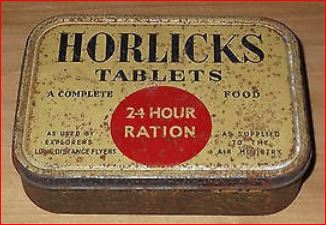 Un aliment complet - Ration de 24 heuresHorlicks de ma boîte. Dans la matinée, un vieux Français est venu examiner ses pièges à lapins près de l'un desquels je posais. Je ne connais pas le français mais j'ai indiqué que j'étais un aviateur anglais et j'ai demandé à manger. Je n'aimais pas son apparence alors j'ai déplacé ma cachette quand il est parti. Vers 14 heures, deux Allemands sont passés, portant des casques d'acier et des fusils ; il semblait qu'ils me cherchaient. Ils ne m'ont pas vu. J'ai quitté le bois vers 21 heures et, après l'avoir quitté, j'ai continué vers le sud. A l'est de Falaise, la voie ferrée était gardée par des patrouilles anti-sabotage françaises et j'ai eu quelques difficultés à traverser. Vers 3 heures du matin, je me suis caché dans un hangar, en partie parce qu'une tempête arrivait et en partie parce que ma jambe me faisait très mal. Au point du jour, j'ai vu que ma jambe présentait des signes d'empoisonnement du sang, alors je me suis rendu dans une ferme à Pertheville-Ners, où j'ai indiqué aux gens que j'étais anglais. Ils m'ont apporté de la nourriture et m'ont caché dans une grange. Le soir, on m’a conduit à la maison, et la fermière, après m'avoir fait un cataplasme à la jambe, m'a envoyé me coucher. Je suis resté au lit pendant environ trois semaines. Je suis resté à la ferme jusqu'à fin août lorsqu'une organisation m'a pris en charge. APPENDIX C - Le 19 avril 43, je trouvai refuge chez Mr et Mme Legris, Pertheville-Ners, par Falaise, Calvados. Le troisième ou quatrième jour arrive une nièce de mes hôtes, Melle Lemoine, 6 rue Emile Duclos, Suresnes [NDLR - Courbevoie], Seine, venait de Paris. Elle parlait un peu anglais et a dit qu'elle connaissait un homme travaillant dans une organisation d'espionnage. Cet homme, cependant, était trop occupé pour aider mais la mère de Mlle Lemoine connaissait un autre homme lié à une organisation française qui se rendait régulièrement en Suisse. Mlle Lemoine m'a photographié trois fois pour mes cartes d'identité mais rien ne s'est passé jusqu'à ce que l'ami de sa mère, alors qu'il traversait la frontière suisse lors d'un de ses voyages, a rencontré Marie Claire. Elle a dit qu'elle prendrait soin de moi. Rapport de fuite (P/O Whitnall) - ( About two weeks later she sent Mlle. Lemoine for more photographs and arranged for a girl to bring me an identity card, a ration card, and a doctor's certificate saying I could not speak for 10 days because of throat operation. This girl, who came from Lyons, took me towards the end of Aug to Ruffec and thence by bicycle to a farm, about 25 kms. S.E. of Ruffec, which Marie Claire used on her journeys. Marie Claire, who met us at the station at Ruffec, did not accompany us to the farm. I stayed for about four days at the farm with an American civilian (Haviland), who had been a member of the U.S. Ambulance Corps. The young woman went back to the hotel at Ruffec, and after four days came to the farm and took Haviland and myself to the main road where Marie Claire and another lady waiting with a truck. They took the American to a railway station (name unknown) where he met Sgt. Sansoucy. They went by train. Marie Claire, the young woman, and I went to Ruffec in the truck, and I stayed the night at a hotel. About 0200 hrs, Sgt. Trott came to the hotel. Sgt. Sheppard and Sgt. Sparkes went to another house in the same road that night. About 0500 hrs we set off by car. The party consisted of Sgt. Sheppard, Sgt. Trott, Sgt. Sparkes, myself, Marie Claire, a pilot officer in civilian clothes, and the driver of the truck. We went South to Toulouse and Varihles, North of Foix. Here Marie Claire handed us over to a Spaniard. We stayed in a shed till daylight, when the Spaniard hid us for the day beside a river. The same party left a night. The Spaniard took us about 2 kms. And handed us to a Frenchman after taking all our money from us. The Frenchman took us about 5 kms. That night to a farm in the mountains where we stayed two nights and three days (10 - 12 Sep), waiting for a party of Frenchmen. The farm was at St Jean de Vierges. On the third night (12 Sep) we started our journey proper with a party of about 20 French civilians. The guides took us to just short of the Spanish frontier (16 Sep) and left with all the Frenchmen. At the same time two guides came from Andorra to pick up the British members of the party, who had been joined by a Polish family and two Polish soldiers. We arrived in Andorra on the morning of 17 Sep. We walked to a village N.W. of the town of Andorra and at a farm met Carlos, a Spaniard in the organisation. He took us by car to a hotel in St. Julia where we stayed the night (17-18 Sep). We left for Spain on the night of 18-19 Sep and arrived at Seo-de-Urgel, whence we were taken to Barcelona by car. We were three days in Barcelona, and two days in Madrid, and arrived at Gibraltar on 1 Oct. Original) – source : Nat Arch UK WO 208/3315/1445 PARTIE II – Traduction Ph Laroyenne Environ deux semaines plus tard, elle envoya Mlle Lemoine pour prendre d'autres photos et a demandé à une fille de m'apporter une carte d'identité, une carte de rationnement et un certificat médical attestant que je ne pouvais pas parler pendant 10 jours à cause d'une opération à la gorge. Cette fille, venue de Lyon, m'a emmené vers la fin août à Ruffec et de là en vélo jusqu'à une ferme, à environ 25 kms. S.E. de Ruffec, que Marie Claire utilisait lors de ses voyages. Marie Claire, qui nous a accueillis à la gare de Ruffec, ne nous a pas accompagnés à la ferme. Je suis resté environ quatre jours à la ferme avec un civil américain (Haviland), qui avait été membre du corps des ambulances américaines. La jeune femme est retournée à l'hôtel de Ruffec et, après quatre jours, elle est arrivée à la ferme et nous a emmené Haviland et moi jusqu'à la route principale où Marie Claire et une autre dame attendaient avec un camion. Ils ont emmené l'américain à une gare (nom inconnu) où il a rencontré le Sgt Sansoucy. Ils sont partis en train. Marie Claire, la jeune femme, et moi sommes allés à Ruffec en camion ; j'ai passé la nuit dans un hôtel. Vers 02h00, le Sgt Trott est arrivé à l'hôtel. Le Sgt Sheppard et le Sgt Sparkes se sont rendus dans une autre maison sur la même route cette nuit-là. Vers 05h00, nous sommes partis en voiture. Le groupe était composé du Sgt Sheppard, du Sgt. Trott, du Sgt Sparkes, moi-même, Marie Claire, un officier pilote en civil et le chauffeur du camion. Nous sommes allés au sud vers Toulouse et Varilhes, au nord de Foix. Ici, Marie Claire nous a remis à un Espagnol. Nous sommes restés dans un hangar jusqu'au jour puis l'Espagnol nous a cachés pour la journée au bord d'une rivière. Le même groupe est parti à la nuit. L'Espagnol a fait avec nous environ 2 km et nous a remis à un Français après nous avoir pris tout notre argent. Le Français nous a fait faire environ 5 km cette nuit-là jusqu’à une ferme dans les montagnes où nous sommes restés deux nuits et trois jours (du 10 au 12 septembre), en attendant un groupe de Français. La ferme était à St Jean de Verges. La troisième nuit (12 septembre), nous avons commencé notre voyage proprement dit avec un groupe d'environ 20 civils français. Les guides nous ont emmenés juste avant la frontière espagnole (16 septembre) et sont repartis avec tous les Français. Au même moment, deux guides ont venus d'Andorre pour récupérer les membres britanniques du groupe, rejoints par une famille polonaise et deux soldats polonais. Nous sommes arrivés en Andorre le matin du 17 septembre. Nous avons marché jusqu'à un village au nord-ouest de la ville d'Andorre et dans une ferme, j'ai rencontré Carlos, un Espagnol de l'organisation. Il nous a emmenés en voiture dans un hôtel de Sant Julia où nous avons passé la nuit (17-18 septembre). Nous sommes partis pour l'Espagne dans la nuit du 18 au 19 septembre et sommes arrivés à La Seu-d’Urgell, d'où nous avons été conduits à Barcelone en voiture. Nous sommes restés trois jours à Barcelone et deux jours à Madrid et sommes arrivés à Gibraltar le 1er octobre. Rapport 19/04/1943 (" Plane crash in Ernes on the night of April 17-18, 43. One of the occupants killed. The second was reportedly taken prisoner after parachuting." Original) – source : Gendarmerie de Pont-l’Evêque, via J-M Chandavoine "Chute d’un avion à Ernes dans la nuit du 17 au 18 Avril 43. Un des occupants tué. Le second aurait été fait prisonnier après avoir sauté en parachute." Fiche avec photos sur www.aircrewremembered.com (lien communiqué par Richard Sobinski)
|