| |
(Images transmises par Michel Auburtin)
Moteur V-1710 n° AO-51347 - Armement : 20mm n° 123673 / Cal .50 1542527 1542550 1542375 1542372.
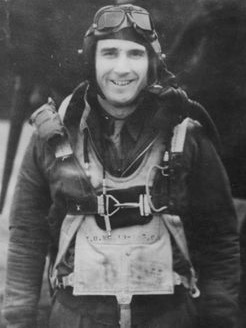
Rapport (2Lt Amy) - (On 14 August 1944 at approximately 1215 I was flying #4 in Backdoor Red Flight, Capt Robert A Cranmer was flying # 2 on Lt Col Darling, Capt Cranmer spotted a truck and after calling it in was told to go down and strafe it. He had, judging from the speed of my ship, over 300 MPH on his strafing run at an anle of about 20 degrees to the ground. He was blocked from my sight for about 3 to 4 seconds, when he did not pull up I rolled my wing down to look. I was about 3000 feet and he was approximately 100 to 200 feet, he leveled out of a very slight turn with the whole right wing a sheet of flame extending past the tail surface. I did not see him drop his bombs nor make any attempt to bail out, I believe he was trying to crash land in a field when he hit a patch of trees two or three acres in size and the ship blew completely up on impact. Pieces of his ship were scattered over the area of the woods which were all in flames.Original) - MACR 7640 - source : Nat Arch US - Traduction DC via Google Lens):
Le 14 août 1944, vers 12 h 15, je volais en n° 4 au sein de la section Backdoor Red ; le capitaine Robert A. Cranmer occuvolait en n° 2, aux côtés du Lt Col Darling. Le capitaine Cranmer repéra un camion et, après l'avoir signalé par radio, reçut l'ordre de descendre pour le mitrailler. À en juger par la vitesse de mon propre appareil, il devait voler à plus de 300 miles à l'heure (environ 480 km/h) lors de son passage de mitraillage, en suivant une trajectoire inclinée d'environ 20 degrés par rapport au sol. Il disparut de mon champ de vision pendant trois ou quatre secondes ; ne le voyant pas redresser, j'inclinai mon avion pour mieux voir. Je me trouvais à une altitude d'environ 3 000 pieds (900 mètres) et lui à quelque 100 ou 200 pieds (30 à 60 mètres) ; il sortait d'un virage très léger et se remettait à plat, mais son aile droite était entièrement la proie des flammes, une nappe de feu s'étendant jusqu'au-delà de l'empennage. Je ne le vis ni larguer ses bombes ni tenter de s'éjecter ; je pense qu'il essayait d'effectuer un atterrissage forcé dans un champ lorsqu'il percuta un bosquet d'une superficie de deux ou trois acres (environ 0,8 à 1,2 hectare), l'appareil explosant totalement à l'impact. Des débris de son avion furent éparpillés sur la zone boisée, qui était entièrement en feu.
Photos de la stèle sur le site Aérosteles
| |


 Département