|
Crash - Avro Lancaster - type B I - s/n LL842 VN°F |

|
|
|
Crash - Avro Lancaster - type B I - s/n LL842 VN°F |
|
| Fiche France-Crashes 39-45 modifiée le 27-08-2026 | |||||
| Date | Nation |
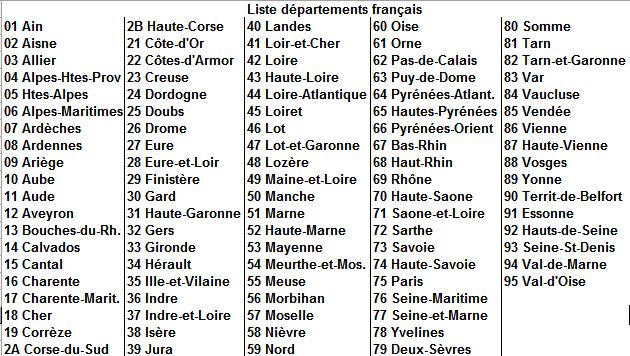 Département Département |
Unité | - | Mission |
|---|---|---|---|---|---|
| 24-07-1944 | Angleterre/Common. | Eure et Loir | 50 Sq RAF | Stuttgart (All) | |
| Localisation | Le Moulin Le Comte - 2 km SSO Nogent-le-Rotrou |
|---|---|
| Circonstances | Abattu par un chasseur de nuit piloté par Ofw. Wilhelm Glitz du Stab NJG2 à 23h56 |
| Commentaires | Décollage 21h51 le 24/7 Skellingthorpe, Lincolnshire UK |
| Sources ** |
Listes des bombardiers et équipages perdus: Royal Air Force - Bomber Command Losses of the Second World War par WR Listes des bombardiers et équipages perdus: Royal Air Force - Bomber Command Losses of the Second World War par WR Chorley WR Chorley / CWGC / BomberCommand / RAFcommands / Alain Trouplin (source: www.veterans.gc.ca) |
| Historique | 03/12/2012=Ajout lien article de presse, prénom Hampton - 29/07/2014=Ajout lien,comm évadé - 07/01/2015=Ajout 5 photos - 21/02/2021=Ajout 3 liens,comm RCAF - 27/08/2026=Ajout 3 rapports,comm équip,3 photos |
| Grade | Prenom | Nom | Poste | Corps | Etat |
Lieu d'Inhumation |
Commentaires |
|---|---|---|---|---|---|---|---|
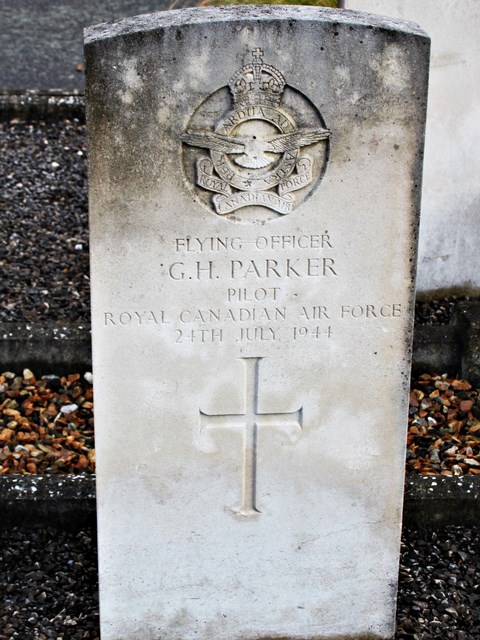
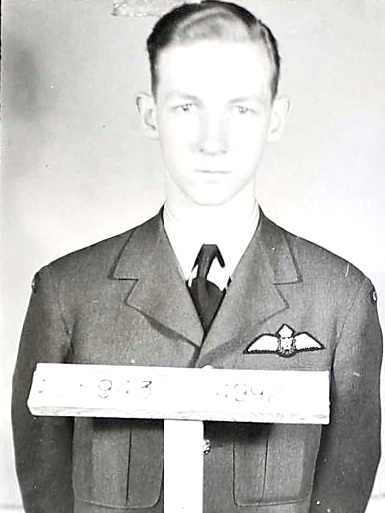
| F/O | Gordon Howard | Parker | Pil | RCAF | Décédé | Cim Com Nogent-le-Rotrou (28) TJ 33.4-7 * | J/25943 - 21 ans - Né le 12/12/1922-R/160320 - Fils de Arthur William et Mary Allen (Greer) Parker, Toronto, Ontario, Canada |
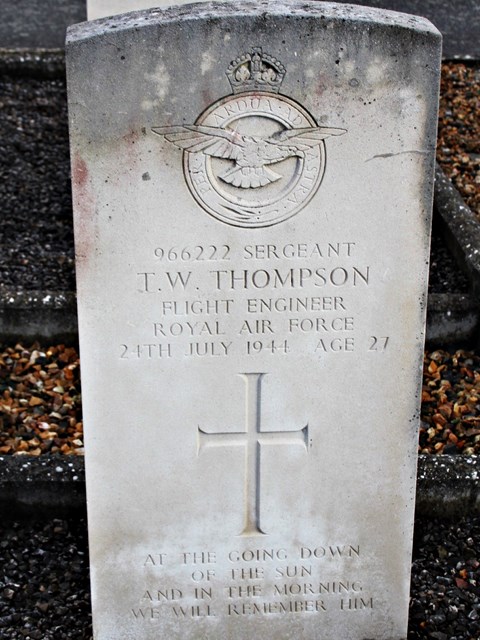
| Sgt | Thomas William | Thompson | Mec | RAF VR | Décédé | Cim Com Nogent-le-Rotrou (28) TJ 33.4-7 * | 966222 - 27 ans - Fils de Peter et Polly Thompson, de Atherton, Lancashire. |
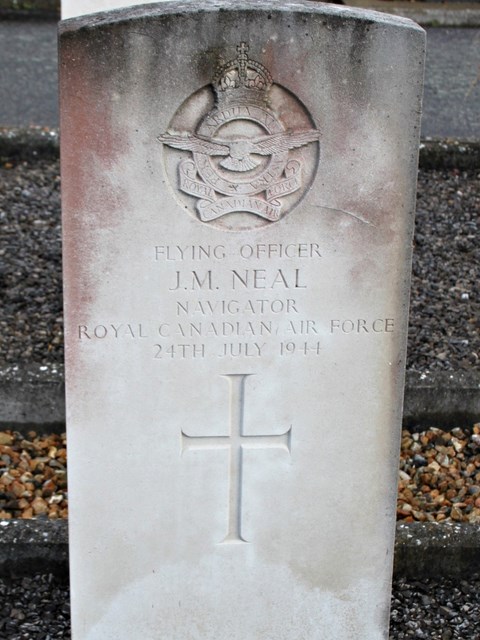
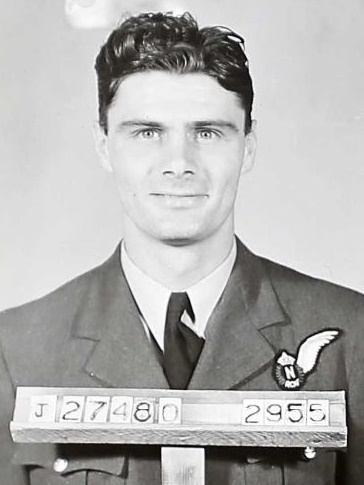
| F/O | John Mason | Neal | Nav | RCAF | Décédé | Cim Com Nogent-le-Rotrou (28) TJ 33.4-7 * | J/27480-R/172070 - 27 ans - Né le 04/01/1917 Winnipeg, Manitoba, Canada - Fils de John Frederick et Elizabeth Lily (Mason) Neal |
| F/Sgt | James Henry | Spencer | Bomb | RAF | Prisonnier | 658681 - Né le 12/11/1919 South Shields, Durham UK - Fils de Richard et Hilda Beatrice (Roberts) Spencer - Légèrement blessé à la tête - Capturé le 25/07/44 à Chartres - Pow 630 - Stalag Luft VII Bankau (07/08/44)/Stalag III-A Luckenwalde (01/02/45-01/05/45) - †1990 Chichester | |
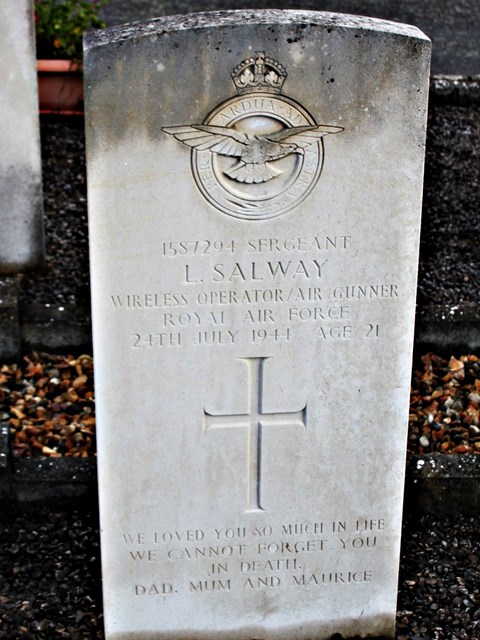
| Sgt | Leslie | Salway | Rad | RAF VR | Décédé | Cim Com Nogent-le-Rotrou (28) TJ 33.4-7 * | 1587294 - 21 ans - Fils de Charles et Carrie Dorothy Salway, de Bristol. |
| Sgt | Roy | Hampton | MitS | RAF | Echappé | 2211450 - Né le 07/02/1915 - Rejoint le maquis de Fréteval (41) - Retour UK 18/08/1944 - Rapport WO 208/3321/2115 - Décédé en 1999 | |
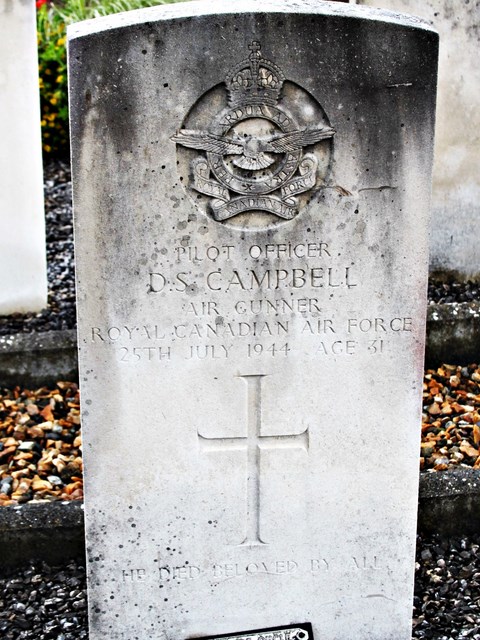
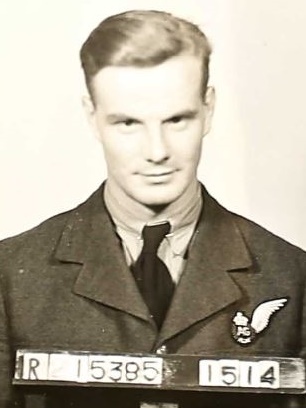
| P/O | David Sinclair | Campbell | MitA | RCAF | Décédé | Cim Com Nogent-le-Rotrou (28) 33.2 * | J/90306-R215385 - 31 ans - Né le 13/01/1913 Vancouver, Br Col, Canada - Fils de Andrew et Cecelia (Sinclair) Campbell - Conjoint de Norma Lorraine Finch - Parachute non ouvert |
| Fiche tech | Correspondance grades | Abréviations utilisées | Filières d'évasion | Camps de Pow | Bases RAF/USAAF | Utilitaires |
|---|
|
Extrait Rapport: - (3. The Mid Upper Turret was turned slightly to port when the aircraft was attacked. The Gunner turned his head to port and immediately saw a very large fire reging in the centre of the port mainplane. He described it as a terrific blaze which lit up everything in the aircraft. As far as he knows the engines were not hit or set on fire. 4. The Pilot immediately called out 'Get to hell out of this as quickly as possible '. He then made some remark about bombs which the Mid Upper Gunner did not catch. The Lancaster was carrying 1 x 2000 lb + 12 'J' Busters and it is possible that the incendiaries had been set alight as when the informant reached the fuselage he found that the forepart was completely filled with smoke and flames. 5. Informant did not leave his turret very speedily as he experienced some difficulty in locating the footbar. He heard the Rear Gunner, who had always expressed the opinion that he would bale out from his turret if he ever had to, announce that he was about to leave. He also believes that the Air Bomber had left before he reached the fuselage. When he did so he immediately took his parachute from its stowage, put it on, opened the rear exit door and baled out head first having removed his helmet. 6. About 5 seconds after leaving the aircraft, informant heard an explosion which threw him about. Later he saw a fire on the ground. His boots were dragged off by the slipstream, but his parachute functioned satisfactorily. He landed among trees from which he remained suspended for about an hour. He tried without success to reach a branch and eventually released his parachute. He fell some distance to the ground and he was stunned and bruised but broke no bones. He landed near the village of Dance about 4 miles north west of Nogent-le-Rotrou.Original) - (source : www.ancestry.fr (Sgt Hampton) - Traduction DC via Google Lens): 3. La tourelle dorsale était légèrement orientée vers bâbord au moment de l'attaque. Le mitrailleur tourna la tête vers bâbord et aperçut immédiatement un immense incendie faisant rage au centre de l'aile gauche. Il décrivit un brasier violent qui illuminait tout l'intérieur de l'appareil. Pour autant qu'il le sache, les moteurs n'avaient été ni touchés ni incendiés. 4. Le pilote ordonna immédiatement : « Foutez le camp d'ici le plus vite possible ! » Il fit ensuite une remarque concernant les bombes, que le mitrailleur dorsal ne saisit pas. Le Lancaster transportait une bombe de 2 000 livres et 12 bombes incendiaires « J » ; il est possible que ces dernières se soient enflammées, car lorsque le témoin atteignit le fuselage, il trouva la partie avant entièrement envahie par la fumée et les flammes. 5. Le témoin ne quitta pas sa tourelle très rapidement, car il eut du mal à localiser le palonnier. Il entendit le mitrailleur de queue — qui avait toujours affirmé qu'il sauterait en parachute directement depuis sa tourelle si jamais il devait évacuer — annoncer qu'il s'apprêtait à partir. Il pense également que le bombardier avait déjà quitté son poste avant qu'il n'atteigne le fuselage. Une fois arrivé là, il saisit immédiatement son parachute dans son logement, l'enfila, ouvrit la porte de sortie arrière et sauta tête la première après avoir retiré son casque. 6. Environ cinq secondes après avoir quitté l'appareil, le témoin entendit une explosion qui le projeta violemment. Plus tard, il aperçut un incendie au sol. Ses bottes furent arrachées par le souffle du vent relatif, mais son parachute fonctionna correctement. Il atterrit dans des arbres, où il resta suspendu pendant environ une heure. Il tenta en vain d'atteindre une branche et finit par se détacher de son parachute. Il fit une chute jusqu'au sol ; sonné et contusionné, il ne se fractura toutefois aucun os. Il atterrit près du village de Dance, à environ quatre miles au nord-ouest de Nogent-le-Rotrou. Rapport: - (DATE: 12-4-46 Our Ref 1MREU/S8/XF690/Air Date reported missing 24-7-47 Place of Crash Moulin-le-Comte A15/V89 Place of Burial Nogent Le Rotrou Al5/V89 RESULT OF INVESTIGATION AND FINDINGS: I visited M. Tellier at Moulin-ke-Gomte, which is a commune of Nogent-Le-Rotrou. He confirmed that a British bomber crashed on his property on the 24-7-44 at 23.45 hours. The Germans told him there were four bodies badly carbonised. He only saw the four coffins. But he did see another airman that jumped whose parachute failed to open. This body was badly broken up. The Germans put it in a coffin and took it away with the other four. All five are buried in the cemetery at Nogent-Le-Rotrou. There are five graves exceptionally well kept. Each has a wooden cross with a Union Jack painted on it and an inscription in Germain. On four of them the inscription is There are five graves exceptionally well kept. Union Jack painted on it and an inscription in German. "UNBEKANNT GEFALLEN 24-7-1944. BEI: NOGENT-LE-ROTROU. The other is; "CAMPBELL CAN AIRMAN GEFALLEN 24-7-1944 BEI: NOGENT-Le-ROUTROU. No one seems to know how the Germans identified the body of Campbell. But they presumed it was the airman whose parachute failed to open. The graves are in square 33. One airman was believed to have evaded, as a parachute was found in the woods. Another took refuge at a Mme. T… at "C…", Commune of St. Hilaire-Sur-Erre (orne). A15/V67. But after a day or two Mme T… became panic stricken and turned him over to the Germans. This airman had been wounded so the Germans put him in hospital. I visited Dr. Jean Coudray who attended him, but he said there was little wrong with him. He couldn't tell me where the Germans took him when he was released from hospital Neither could he tell me his name. Five dead - presumably one evader and one taken prisoner. This accounts for seven of the crew. If there were more no one seems to know anything about them. On visiting the crash which consists mainly of a lot of charred pieces of metal - I would say it was a Lancaster. I was able to extract from part of the wing the plate I am attaching herewith. The other plate was given to me by M. Tellier. Also the burnt pieces of escape money. Mr. Tellier said the Germans told him the airmen were Canadians. The graves have not been registered. Exhumation of these bodies may assist in identification. This is all the information I was able to obtain on this case.Original) - (source : Ancestry.fr 1MREU ) - Traduction DC via Google Lens): DATE : 12/04/1946 Notre réf. : 1MREU/S8/XF690/Air Date de disparition signalée : 24/07/1947 Lieu du crash : Moulin-le-Comte (A15/V89) Lieu d'inhumation : Nogent-le-Rotrou (A15/V89) RÉSULTAT DE L'ENQUÊTE ET CONSTATATIONS : Je me suis rendu chez M. Tellier à Moulin-le-Comte, commune de Nogent-le-Rotrou. Il a confirmé qu'un bombardier britannique s'était écrasé sur sa propriété le 24/07/1944 à 23 h 45. Les Allemands lui ont indiqué qu'il y avait quatre corps gravement carbonisés. Il n'a vu que les quatre cercueils. Cependant, il a aperçu un autre aviateur qui avait sauté en parachute, mais dont le parachute ne s'était pas ouvert. Ce corps était atrocement mutilé. Les Allemands l'ont placé dans un cercueil et l'ont emporté avec les quatre autres. Les cinq hommes sont inhumés au cimetière de Nogent-le-Rotrou. On compte cinq tombes remarquablement bien entretenues. Chacune est surmontée d'une croix en bois peinte aux couleurs de l'Union Jack et porte une inscription en allemand. Sur quatre d'entre elles, l'inscription est : « UNBEKANNT GEFALLEN 24-7-1944. BEI: NOGENT-LE-ROTROU. » La cinquième porte l'inscription : « CAMPBELL CAN AIRMAN GEFALLEN 24-7-1944 BEI: NOGENT-LE-ROTROU. » Personne ne semble savoir comment les Allemands ont identifié le corps de Campbell. Ils ont toutefois supposé qu'il s'agissait de l'aviateur dont le parachute ne s'était pas ouvert. Les tombes se trouvent dans le carré 33. On a cru qu'un aviateur avait réussi à s'échapper, car un parachute a été retrouvé dans les bois. Un autre a trouvé refuge chez Mme T…, au lieu-dit « C… », dans la commune de Saint-Hilaire-sur-Erre (Orne) (A15/V67). Mais au bout d'un jour ou deux, Mme T… fut prise de panique et le livra aux Allemands. Cet aviateur ayant été blessé, les Allemands le firent hospitaliser. Je rendis visite au Dr Jean Coudray, qui l'avait soigné ; il m'indiqua toutefois que ses blessures étaient légères. Il ne put me dire où les Allemands l'avaient emmené après sa sortie de l'hôpital, ni me communiquer son nom. Cinq morts ; on peut supposer qu'un membre de l'équipage a réussi à s'échapper et qu'un autre a été fait prisonnier. Cela porte le total à sept membres d'équipage. S'il y en avait d'autres, personne ne semble en avoir connaissance. En examinant le site du crash — constitué essentiellement d'une multitude de débris métalliques calcinés (il s'agissait, selon moi, d'un Lancaster) —, j'ai pu extraire d'un tronçon d'aile la plaque que je joins au présent rapport. L'autre plaque m'a été remise par M. Tellier, tout comme les restes calcinés de la monnaie d'évasion. M. Tellier a précisé que les Allemands lui avaient dit que les aviateurs étaient Canadiens. Les sépultures n'ont pas été répertoriées. L'exhumation des corps pourrait faciliter leur identification. Telles sont toutes les informations que j'ai pu recueillir sur cette affaire. Rapport Sgt Hampton: - ( We left SKELLINGTHORPE at 2200 hrs on 24 Jul 44 in a Lancaster aircraft to bomb STUTTGART, but were hit by Flak near NOGENT-LE-ROTROU (France, 1:250,000, Sheet 15, V 89). The aircraft burst in flames, with the fuselage and port main plane burning furiously. The captain (F/O PARKER) said: "Abandon aircraft quickly" so I baled out immediately. I saw no other parachutes open as I came down. I landed in a tree suspended by my parachute. I had also lost both my flying boots. It was very dark and I could not see the ground, but it was no use staying there so I took a chance and dropped. I hurt my spine. Rather dazed, I started walking, which was difficult, for the ground was rough. I arrived at DANCE (V 8497) where a villager gave me a pair of clogs and brought a doctor from NOGENT who treated me for two days. I had walked for about ten miles without footwear. On 27 Jul I was taken by car to a Maquis camp near ST. COSME (V 6290) where I met three Americans - Lt. W. DILLON (Army), Lt. K. HOUGHTON (A.A.A.F.), and S/Sgt. ECKLEY, M. (A.A.A.F.). DILLON said he knew a contact at ORLEANS, so we decided to go there, for this camp did not appeal to us. DILLON said it was a deathtrap. We set out in two parties. I went with ECKLEY. We walked by daylight via LA CHAPELLE - GUILLAUME (V 9269) - AUTHON (V 9278) – LA BAZOCHE (V 9871). At LA BAZOCHE we asked a civilian to way to ORLEANS. This civilian took us to a camp near CHATEAUDUN, where DILLON and HOUGHTON already were. We arrived there on 30 Jul, and remained till 14 Aug, when American troops arrived in the district.Original) - (WO 208/3321/2115 - source : Nat Arch UK - Traduction Ph Laroyenne): Nous avons quitté Skellingthorpe le 24 juillet 1944 à 22 h 00 à bord d'un Lancaster pour aller bombarder Stuttgart, mais nous avons été touchés par la Flak près de Nogent-le-Rotrou (Feuille 15, ZNG Vv8992). L'avion a pris feu, le fuselage et l'aile principale gauche brûlaient violemment. Le commandant de bord (F/O Parker) a donné l'ordre d'évacuer rapidement l'appareil ; je me suis donc immédiatement parachuté. Je n'ai vu aucun autre parachute s'ouvrir pendant ma descente. J'ai atterri dans un arbre, suspendu par mon parachute. J'avais également perdu mes deux bottes de vol. Il faisait très sombre et je ne voyais pas le sol, mais il était inutile de rester là, j'ai donc pris le risque de me laisser tomber. Je me suis blessé à la colonne vertébrale. Encore un peu sonné, je me suis mis en marche, ce qui était difficile car le terrain était accidenté. Je suis arrivé à Dance (Vv8497), où un habitant m'a donné une paire de sabots et a fait venir un médecin de Nogent qui m'a soigné pendant deux jours. J'avais parcouru environ dix miles (16 km) pieds nus. Le 27 juillet, j'ai été conduit en voiture jusqu'à un camp du maquis près de Saint-Cosme[-en-Vairais] (Vv6290), où j'ai rencontré trois Américains : Lt W. Dillon (Army), Lt K. Houghton (A.A.A.F.) et le S/Sgt M. Eckley (A.A.A.F.) |tous deux fiche]. Dillon a dit qu'il connaissait un contact à Orléans ; nous avons donc décidé de nous y rendre, car ce camp ne nous inspirait pas confiance. Dillon le qualifiait de véritable piège mortel. Nous sommes partis en deux groupes. J'ai fait route avec Eckley. Nous avons marché de jour en passant par Chapelle-Guillaume Vv9269), Authon (Vv9278) et La Bazoche (Vv9871). À La Bazoche, nous avons demandé à un civil de nous indiquer le chemin pour Orléans. Ce civil nous a conduits dans un camp près de Châteaudun [Il s'agit du camp de Fréteval], où se trouvaient déjà Dillon et Houghton. Nous y sommes arrivés le 30 juillet et y sommes restés jusqu'au 14 août, date à laquelle les troupes américaines sont arrivées dans la région. Photos F/O Gordon H Parker et documents sur www.veterans.gc.cat (Lien transmis par Alain Trouplin) Photos F/O John M Neal et documents sur www.veterans.gc.cat (Lien transmis par Alain Trouplin) Photos P/O David S Campbell et documents sur www.veterans.gc.cat (Lien transmis par Alain Trouplin)
|