|
Crash - Avro Lancaster - type B I/B III - s/n LM589 JO°Y |

|
|
|
Crash - Avro Lancaster - type B I/B III - s/n LM589 JO°Y |
|
| Fiche France-Crashes 39-45 modifiée le 07-01-2026 | |||||
| Date | Nation |
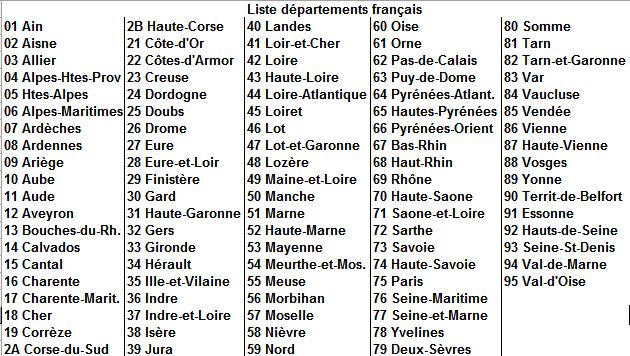 Département Département |
Unité | - | Mission |
|---|---|---|---|---|---|
| 25-07-1944 | Angleterre/Common. | Val d-Oise | 463 Sq RAAF | St-Cyr-l'Ecole : attaque aérodrome | |
| Localisation | Cne de Chaussy - 10 km SO Magny-en-Vexin |
|---|---|
| Circonstances | Abattu par la flak - Avion évacué en parachute - 20h10 |
| Commentaires | Décollage 17h58 le 25/7 Waddington, Lincolnshire UK |
| Sources ** |
Listes des bombardiers et équipages perdus: Royal Air Force - Bomber Command Losses of the Second World War par WR Listes des bombardiers et équipages perdus: Royal Air Force - Bomber Command Losses of the Second World War par WR Chorley WR Chorley / CWGC / BomberCommand / Aérostèles / www.ww2roll.gov.au / rafcommands.com / Ancestry.fr / naa.gov.au |
| Historique | 23/12/2013=Ajout 3 liens photos et fiche - 07/01/2026=Modif géquipage et statut/Ajoiut circ |
| Grade | Prenom | Nom | Poste | Corps | Etat |
Lieu d'Inhumation |
Commentaires |
|---|---|---|---|---|---|---|---|
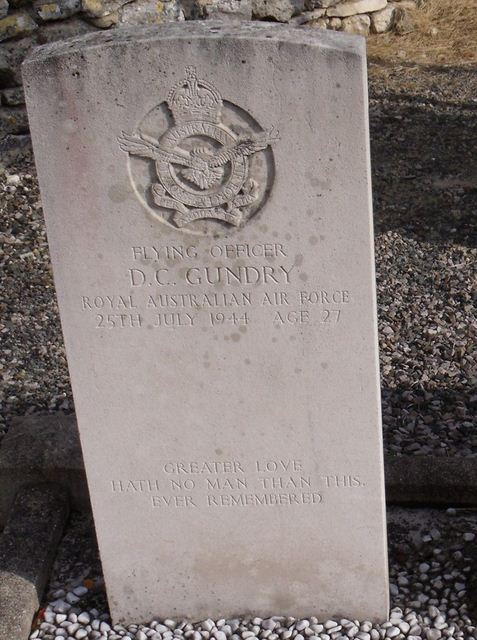
| F/O | Donald Charles | Gundry | Pil | RAAF | Décédé | Cim Com Omerville (95) TJ 1 * | AUS.417833 - 27 ans - Né le 26/12/1916 Toowoomba, QLD, Australia - Fils de Harris Musgrove et Ethel Purland (Windley) Gundry - Conjoint de Quetta Joyce Burge |
| Sgt | Percy Oliver Francis | Wadsworth | Mec | RAF | Prisonnier | 1891750 - Né le 05/02/1916 Ripley, Derbys. UK - Fils de Reginald et Lily May (Flinders) Wadsworth - Conjoint de Joan Barbara Fitzmaurice - Pow 636 - Dulag Luft Oberursel/Stalag Luft VII Bankau (08/44)/Stalag III-A Luckenwalde (21/01/44-07/05/45) - †1988 Walsall | |
| F/Sgt | John Barnes | Sincock | Nav | RAAF | Prisonnier | AUS.417899 - Né le 02/03/1914 Malvern, SA, Australia - Fils de John et Kate Olive (Driscoll) Sincock - Conjoint de Eva May Owens - Blessé au genou à l'atterrissage - Fait prisonnier - Hôpital Luftwaffe de Clichy (25/07/44-26/08/44) - Récupéré et caché par Forces Françaises de l'IntérieurFFI jusqu'à l'arrivée des troupes américaines - †1978 | |
| F/Sgt | Edward John | Fallon | Bomb | RAAF | Prisonnier | AUS.426565 - Né le 21/03/1914 Toowoomba, QLD Australia - Fils de William David et Penelope Rose (Smallridge) Fallon - Conjoint de Agnes Mary Cole - Capturé le 25/07/44 à Beauvais (60) - Pow 575 - Hôpital Brussels (26/07/44)/Stalag Luft VII Bankau (22/08/44)/Stalag III-A Luckenwalde (08/02/45-07/05/45) - †1988 | |
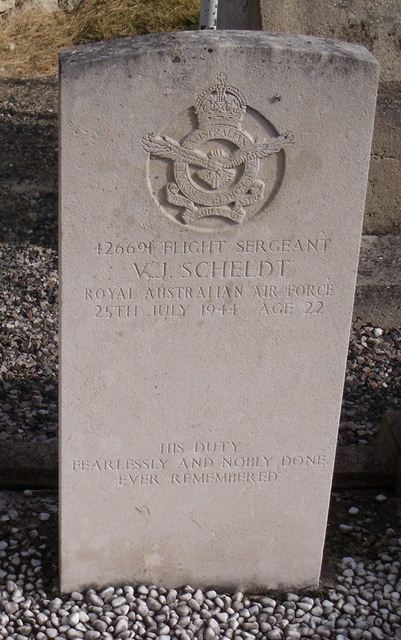
| F/Sgt | Vernon John | Scheldt | Rad | RAAF | Décédé | Cim Com Omerville (95) TJ 1 * | AUS.426691 - 22 ans - Né le 10/05/1922 Brisbane, QLD, Australia - Fils de John Peter et Eleanor Edith (Grove) Scheldt |
| Sgt | Nevin Michael | Davidson | MitS | RAAF | Prisonnier | AUS.426794 - Né le 08/05/1922 Byron Bay, NSW, Australia - Fils de William et Margaret Ann (Burke) Davidson - Conjoint de Nora Elizabeth Murray - Gravement blessé à la jambe par la flak - Aidé à sortir de l'avion par le Radio - Fait prisonnier - Hôpital de la Luftwaffe à Clichy - Libéré par les troupes américaines - †2001 Gympie | |
| F/Sgt | Edward | Burke | MitA | RAAF | Prisonnier | AUS.426527 - Né le 21/02/1921 Toowoomba, QLD, Australia - Fils de Kathleen (Borland) Burke - Conjoint de Joyce Theresa Beauchamp - Pow 559 - Stalag Luft VII Bankau (22/08/44-19/01/45)/Stalag III-A Luckenwalde (08/02/45-07/05/45) - †2007 |
| Fiche tech | Correspondance grades | Abréviations utilisées | Filières d'évasion | Camps de Pow | Bases RAF/USAAF | Utilitaires |
|---|
|
Rapport F/Sgt Sincock - ( On the evening of July 25, 1944, I was the navigator of Lancaster JOY (captained by Flying Officer D.C. Gundry, of Toowoomba, Queensland) which was detailed to attack a target at St.Cyr, France, in an operation shortly before nightfall. Time on target was 8 pm briefed height 8,000 feet. Owing to short notice following an operation the previous night, bombing up was not completed on JOY until 5.52 p.m. - five minutes before setting course time for the formation, and eight minutes before last time of take off. By dispensing with the preliminary run-up of the engines, the skipper succeeded in taking off 30 seconds before last time of take off and overtook the formation finally taking up a position in mid formation with other aircraft packed tightly all around and above. The aircraft's height was 8,000 feet. On the run up to the target flak was very heavy and accurate a carpet of smoke puffs stretching ahead of the aircraft exactly at our height. Before reaching the target, while the bomb-aimer was giving minor corrections the aircraft was heavily hit and vibrated considerably. Unaware that a starboard engine had been hit I presumed at the time that our bombs had taken the shock. Having heard from the mid upper gunner however, that one or more of our starboard engines was on fire before he was hit, it seems certain to me that the engine was set alight by the first burst. The skipper kept perfect control of the aircraft and continued to respond to minor corrections by the bomb aimer, flying through further flak at the same level. Two or three seconds after "Bombs Gone" the aircraft was hit again around the pilot’s engineer's and my positions. This burst seemed to be small stuff, bursting right at our height. The engineer briefly announced that his gauges had all fallen back to zero, adding that he could carry on without gauges. After negotiating the turn with the stream the skipper put the aircraft's nose down and skilfully got it clear of the other aircraft which it had endangered by its proximity to them. A matter of seconds later, the mid upper gunner announced that he had been hit and I informed the skipper that I would get him out of his turret. I had just accomplished this when I was joined at the turret by the wireless operator. Both of us were off inter-com at the time.Original) - PARTIE I Le soir du 25 juillet 1944, j'étais navigateur du Lancaster JOY (commandé par le lieutenant d'aviation D.C. Gundry, de Toowoomba, Queensland), chargé d'attaquer une cible à Saint-Cyr, en France, lors d'une opération prévue peu avant la tombée de la nuit. L'heure d'arrivée prévue était 20 h, l'altitude prévue étant de 8 000 pieds. En raison du court préavis suite à une opération la nuit précédente, le chargement des bombes sur le JOY ne fut achevé qu'à 17 h 52, soit cinq minutes avant le cap fixé pour la formation et huit minutes avant l'heure limite de décollage. En omettant la mise en marche préliminaire des moteurs, le commandant réussit à décoller 30 secondes avant l'heure limite et à dépasser la formation, se positionnant finalement au milieu de celle-ci, les autres appareils étant serrés tout autour et au-dessus de lui. L'altitude de l'avion était de 8 000 pieds. Durant la montée vers la cible, la DCA était très intense et précise, un tapis de fumée s'étendant devant l'avion exactement à notre altitude. Avant d'atteindre la cible, alors que le bombardier effectuait de légères corrections, l'avion fut violemment touché et subit de fortes vibrations. Ignorant qu'un moteur tribord avait été touché, je supposai alors que nos bombes avaient encaissé le choc. Cependant, ayant entendu le mitrailleur dorsal m'indiquer qu'un ou plusieurs de nos moteurs tribord étaient en feu avant qu'il ne soit touché, il me semble certain que le moteur a pris feu lors de la première explosion. Le commandant de bord garda une maîtrise parfaite de l'appareil et continua de répondre aux légères corrections du bombardier, volant à travers les tirs de DCA au même niveau. Deux ou trois secondes après le largage des bombes, l'avion fut de nouveau touché près de nos positions respectives. Cette explosion semblait être de faible intensité, survenant juste à notre altitude. L'ingénieur a brièvement annoncé que tous ses indicateurs étaient revenus à zéro, ajoutant qu'il pouvait continuer sans indicateurs. Après avoir négocié le virage avec le flux d’avions, le commandant de bord piqua du nez et s'éloigna habilement des autres appareils qu'il avait mis en danger par sa proximité. Quelques secondes plus tard, le mitrailleur de tourelle supérieure annonça qu'il avait été touché et j'informai le commandant que j'allais le faire sortir de sa tourelle. Je venais de le faire lorsque le radio me rejoignit. Nous étions tous deux hors service à ce moment-là. Rapport F/Sgt Sincock - ( Observing that fire had broken out near the wireless operator's position I shouted to the wireless operator to take charge of the mid upper gunner and moved forward to tackle the fire. Crossing the fire which was rising from a hole about four inches in diameter in the center of the main spar, I seized my extinguisher and plugged in on inter com informing the skipper of the fire. "Fight it with extinguisher" he said. Although I emptied the extinguisher holding the nozzle down into the hole in the main spar it had no effect. It did not seem to be reaching the seat of the flames. On my reporting to the skipper that the extinguisher was unavailing, he gave the emergency order to jump "Alright fellows, "chutes, Jump Jump". Two minutes or more must have elapsed since the engine had caught fire when this order was given. It seems probable to me from the speed with which the bomb aimer got the hatch open, and bailed out that a preparatory order had been given while I was off inter-com. While putting on my parachute I could see the wireless operator helping the mid upper gunner. They were both on their feet and were just disappearing behind the mid upper turret as they moved towards the rear escape hatch. After getting the skipper's parachute from where it was stowed above in the roofing of the engineer's panel, I checked it for ripcord on the right hand side and put it on the skipper. I then took a step back and looked down the fuselage of the aircraft. Despite the fact that less flame and more smoke was coming from the hole in the main spar it was possible to see that the fuselage was clear as far as the mid upper turret. Thinking that the pilot and I were the last to bale out of the aircraft I squeezed his arm and went down to the nose to bail out. I have a peculiar impression that I had to bail out twice that my first attempt was unsuccessful and that, finding myself till in the aircraft, half over the escape hatch and half to the port side I had to seize both sides of the aircraft's escape hatch and flex my shoulders to get through. I have no recollection of the descent or even of pulling my ripcord but since, for four or five days the muscles supporting the back of my neck gave pain, I presume that my head was snapped back by the slipstream, rendering me unconscious.Original) - PARTIE II: Constatant qu'un incendie s'était déclaré près du poste de l'opérateur radio, je lui ai crié de prendre le commandement du mitrailleur dorsal et me suis avancé pour combattre le feu. Traversant les flammes qui jaillissaient d'un trou d'une dizaine de centimètres de diamètre au centre du longeron principal, j'ai saisi mon extincteur et me suis branché à l'interphone pour informer le commandant de l'incendie. « Utilisez l'extincteur », a-t-il dit. Bien que j'aie vidé l'extincteur en maintenant la buse vers le bas dans le trou du longeron principal, cela n'a eu aucun effet. L'extincteur ne semblait pas atteindre le foyer des flammes. Après avoir signalé au commandant que l'extincteur était inefficace, il donna l'ordre d'urgence de sauter : « Allez les gars, parachutes, sautez ! Sautez ! » Deux minutes, voire plus, avaient dû s'écouler depuis l'incendie du moteur lorsque cet ordre fut donné. Vu la rapidité avec laquelle le bombardier ouvrit la trappe et sauta, il me semble probable qu'un ordre préparatoire avait été donné pendant que j'étais hors service. Pendant que j'enfilais mon parachute, je vis le radio aider le mitrailleur dorsal. Ils étaient tous deux debout et disparaissaient derrière la tourelle dorsale en se dirigeant vers la trappe d'évacuation arrière. Après avoir récupéré le parachute du commandant, rangé dans le toit du tableau de bord du mécanicien, je vérifiai la présence de la poignée d'ouverture sur le côté droit et l'enfilai. Je reculai ensuite d'un pas et observai le fuselage. Malgré le fait que les flammes étaient moins nombreuses et la fumée plus abondante au niveau du trou dans le longeron principal, on pouvait constater que le fuselage était dégagé jusqu'à la tourelle supérieure centrale. Pensant que le pilote et moi serions les derniers à sauter de l'appareil, je lui serrai le bras et descendis vers le nez pour m'éjecter. J'ai l'étrange impression d'avoir dû m'éjecter deux fois, ma première tentative ayant échoué. Me retrouvant coincé dans l'avion, à moitié au-dessus de la trappe d'évacuation et à moitié sur le côté gauche, je dus m'agripper aux deux côtés de la trappe et contracter mes épaules pour passer. Je n'ai aucun souvenir de la descente, ni même du moment où j'ai actionné la poignée d'éjection. Cependant, les muscles de ma nuque me faisant souffrir pendant quatre ou cinq jours, je suppose que le souffle du vent m'a projeté la tête en arrière, me faisant perdre connaissance. Rapport F/Sgt Sincock - ( When consciousness returned I was a German hands in the act of being removed from a motor vehicle at a small country first aid station. There I saw for a moment the mid upper gunner. Subsequently I saw the bomb aimer, rear gunner and engineer. All were perfectly fit with the exception that the bomb aimer had suffered a collapse of the muscles at the back of the neck, similar to my own. At the first aid outpost where I had seen the mid upper gunner, I had been searched and in company with the bomb aimer, rear gunner and engineer I was searched again at a small country outpost on the way to the Paris. On that occasion my astro watch, which had been missed in the first search was taken from me and the searcher took one of my identity discs, leaving me with the other. The Bomb Aimer, engineer and rear gunner were told to leave the lorry on which we were taken to Paris before me. They understood they were being taken straight on to Germany. Because of injuries to my legs I was taken to the Luftwaffe Hospital, Clichy, Seine just north of Paris proper where I remained in German hands until the morning of August 18. That morning the German hospital staff left us in the hands of French doctors and staff. In 3 attempts by S.S. to remove us in lorries the French successfully hid me and a number of others, finally smuggling me and six others out of the hospital hiding us in a home for old women where we remained until the Americans entered Paris I was then evacuated through the American hospital system and was finally flown to this country in a Dakota. Before completing this report I should like to comment on the skill, bulldog determination and gallantry of our skipper. This man by no means the first occasion on which had seen them. His pluck and skill and determination were always evident and he always cool in emergencies. On 25 July he was the same courageous determined skipper he had always been. When we were hit on our bombing run it was our bombs which come first. With them on their way to the target the safety of the other aircraft was endangered by ours he lost precious height. With that danger past and only then he thought of his own aircraft and crew. He held on beyond all the bounds of duty and courage, in my opinion. He had an engine in fire and heard of another fire in the fuselage, and he said "Fight it with extinguishers". He fought to keep his aircraft flying, and his crew together. Whence he finally gave the order to jump he left himself little or no time to get out. His own life came last, and he had everything to live for. It was an honor to fly with him and a still greater honor to be his friend.Original) - PARTIE III: Quand j'ai repris conscience, j'étais aux mains d’un Allemand, en train d'être extrait d'un véhicule dans un petit poste de secours rural. J'y ai aperçu un instant le mitrailleur de tourelle. Puis j'ai vu le bombardier, le mitrailleur arrière et le mécanicien. Tous étaient en parfaite santé, à l'exception du bombardier qui avait subi un affaissement des muscles de la nuque, semblable au mien. Au poste de secours où j'avais vu le mitrailleur de tourelle, j'avais été fouillé, et en compagnie du bombardier, du mitrailleur arrière et du mécanicien, j'ai été fouillé une nouvelle fois dans un petit poste de secours rural sur la route de Paris. À cette occasion, ma montre astronomique, qui avait échappé à la première fouille, m'a été prise, et le fouilleur a pris l'une de mes plaques d'identité, me laissant l'autre. On a ordonné au bombardier, au mécanicien et au mitrailleur arrière de quitter le camion qui nous emmenait à Paris avant moi. Ils savaient qu'ils étaient conduits directement en Allemagne. En raison de mes blessures aux jambes, j'ai été transporté à l'hôpital de la Luftwaffe de Clichy, sur les bords de la Seine, juste au nord de Paris, où je suis resté aux mains des Allemands jusqu'au matin du 18 août. Ce matin-là, le personnel hospitalier allemand nous a confiés aux médecins et au personnel français. Lors de trois tentatives des SS pour nous évacuer en camion, les Français ont réussi à me cacher, ainsi que plusieurs autres personnes, et ont finalement réussi à nous faire sortir clandestinement, moi et six autres, de l'hôpital. Nous nous sommes cachés dans une maison de retraite où nous sommes restés jusqu'à l'entrée des Américains à Paris. J'ai ensuite été évacué par le biais du système hospitalier américain, puis rapatrié à bord d'un Dakota. Avant de conclure ce rapport, je tiens à souligner le courage, la ténacité et la bravoure de notre commandant. Ce n'était certainement pas la première fois que je voyais un tel homme. Son courage, son habileté et sa détermination étaient toujours manifestes, et il gardait toujours son sang-froid dans les situations d'urgence. Le 25 juillet, il était le même commandant courageux et déterminé qu'à l'accoutumée. Lorsque nous avons été touchés lors de notre mission de bombardement, ce sont nos bombes qui ont été touchées en premier. Alors qu'ils se dirigeaient vers leur cible, la sécurité des autres appareils était compromise par la nôtre, et il perdit une altitude précieuse. Une fois le danger écarté, il pensa enfin à son avion et à son équipage. À mon avis, il s'accrocha avec un courage et un dévouement exceptionnels. Un moteur prit feu, et lorsqu'il entendit parler d'un autre incendie dans le fuselage, il ordonna : « Combattez-le avec des extincteurs ! » Il lutta pour maintenir son avion en vol et son équipage uni. Lorsqu'il donna finalement l'ordre de sauter, il ne se laissa pratiquement aucune chance de s'éjecter. Sa propre vie passait après tout, et pourtant, il avait toute la vie devant lui. Ce fut un honneur de voler avec lui, et un honneur encore plus grand d'être son ami. Extrait de Rapport: - ( Sgt Sincock - Prisoner of war - 25.7.44 - Operational target St.Cyr France. Veteran was in German prison Hospital Luftwaffen lazaret as Clichey Seine (near Paris). Was in German hands from 25.7.44 - 26/8/44. Hidden by FFI until Americans entered Paris. Then evacuation through American Hospital to UK.Original) - (Source : Archives RAAF Sgt Sincock Form PP25 – Traduction DC via Google): Sgt Sincock - Prisonnier de guerre - 25/07/44 - Objectif opérationnel : Saint-Cyr, France. Ce vétéran était détenu à l'hôpital-prison allemand Luftwaffen-Lazaret de Clichy-Seine (près de Paris). Il est resté aux mains des Allemands du 25/07/44 au 26/08/44. Caché par les FFI jusqu'à l'entrée des Américains à Paris, il a ensuite été évacué vers le Royaume-Uni via un hôpital américain. Photos de la stèle et tombes sur le site Aerosteles
|